
Author’s Note
I came to Edward Hopper rather late.
I had encountered him briefly while studying contemporary art history at university, but the encounter left little more than a trace. My own tastes tended, and still tend, toward classicism and the Italian Renaissance: toward paintings shaped by older worlds, monumental subjects, carefully ordered compositions, and the long cultural memory of Europe. Hopper’s diners, gas stations, hotel rooms, and anonymous brick buildings appeared to belong to an entirely different visual universe.
Then, several months ago, I came across Nighthawks again. This time, I stopped.
It was the obvious point of entry, perhaps the most famous image in twentieth-century American painting. Yet familiarity had not exhausted it. The more I looked, the stranger it became. Four people share a brightly lit diner, but the scene offers no real sense of companionship. The glass allows us to see everything while keeping us outside. The city is present, yet almost completely empty. Nothing happens, and still the painting feels charged with the possibility that something has just happened, or is about to.
Curiosity did what it often does to me. I began looking beyond the single image. I read about Hopper, bought books, studied other paintings, and tried to inhabit his work rather than merely recognize it. In the process, Nighthawks opened onto a larger America: roads at dusk, apartments in the morning, theaters between performances, storefronts before opening, houses beside railway tracks. Eventually another painting, Morning Sun, affected me even more deeply.
This essay is therefore not an attempt to present Hopper’s entire career, nor to force his art into a political argument it was never designed to carry. It is a reflection on three paintings, Gas, Nighthawks, and Morning Sun, and on what they preserve of American history. Hopper did not paint presidents, elections, wars, or mass movements. He painted the spaces in which Americans lived while history was happening elsewhere.
That, I have come to believe, makes him a historian of a particular kind: a painter of America’s silent hours.
I. Coming to Hopper Late
There is a difference between knowing an image and encountering it. I had known Nighthawks for years through reproductions, references, and the vague confidence that recognition amounts to understanding. It does not. Sometimes an artwork waits until we have acquired the patience to see what was there all along.
My late return to Hopper was surprising precisely because his world seems so far removed from the art I usually love. Renaissance painting often draws the eye toward fullness: sacred history, civic order, human gesture, symbolic detail, bodies arranged within meaningful space. Hopper removes almost everything. His rooms are spare. His streets are quiet. His figures rarely perform for us. Meaning does not announce itself through allegory; it gathers slowly around light, distance, and silence.
And yet the distance between these traditions may not be as absolute as I first imagined. Hopper’s paintings are built with extraordinary care. Architecture is never merely background. Windows divide the visible world. Walls, counters, roads, and shafts of sunlight organize the human figure within space. If Renaissance light often reveals order or sacred meaning, Hopper’s light reveals presence without explaining it. It tells us that a person is here, at this hour, in this room, but not what that person feels or what will happen next.
His own path helps explain this balance between observation and inward reconstruction. Born in Nyack, New York, in 1882, Hopper studied at the New York School of Art, traveled to Paris three times between 1906 and 1910, and supported himself for years as a commercial illustrator. He often sketched in the streets before reworking what he had seen in the studio. He married the artist Josephine “Jo” Nivison in 1924, and the couple lived and worked for decades at 3 Washington Square North in Greenwich Village.
Hopper is generally called a realist, but his realism is not simple documentation. His places are observed, remembered, combined, emptied, and rebuilt. A diner may begin with a restaurant glimpsed in Greenwich Village, yet become something that never existed exactly as painted. A gas station may be assembled from several roadside memories. An apparently ordinary scene is therefore both American fact and private invention.
This matters historically. Hopper’s paintings are not photographs of American life, and we should not treat them as neutral evidence. They are something more elusive: records of how modern America could feel when filtered through one exceptionally attentive imagination.
II. History at Human Scale
Hopper’s mature career unfolded across one of the most transformative periods in American history. He was born in the age of railroads and died in the age of television, interstate highways, and the space race. During his lifetime, the United States became an urban and industrial power, endured depression and world war, expanded its consumer culture, and reorganized everyday life around new forms of mobility.
The scale of that transformation can be expressed statistically. The 1920 census marked the first time that more than half of the American population was classified as urban. Yet Hopper rarely paints urbanization as a triumphant skyline or a crowd in motion. His New York remains strangely horizontal and human in scale. He turns away from monuments and toward rented rooms, shopfronts, offices, elevated railway views, cafeterias, theaters, and street corners.
Windows are especially important. They make private life visible from public space while preserving the separation between the observer and the observed. They promise access and deny it at the same time. The Whitney has described Hopper’s New York as an exploration of the meeting between public and private, one shaped by the paradox of being alone within a crowd. That paradox belongs to the history of modern urban life as surely as new buildings, growing populations, or expanding transit networks do.
The same is true beyond the city. Hopper painted railways, roadside businesses, hotels, and service stations, the infrastructure of an increasingly mobile society. But he was less interested in speed than in interruption. His travelers pause, his hotel guests wait, and his roads curve out of sight. The great American promise of movement is present everywhere, but Hopper chooses the moment when movement stops.
This is where his art enters the historical imagination. Political history privileges decisions, elections, crises, victories, and defeats. Social history moves closer to ordinary lives, but its evidence often comes in categories: employment, migration, housing, consumption, class. Hopper preserves something such categories struggle to capture: the emotional atmosphere of inhabiting the structures they describe.
What did modernity feel like after the office closed? What did mobility feel like at a deserted station? What did urban density feel like from a room in which one person sat alone? Hopper never answers directly. He gives those questions a physical setting.
III. Gas: The Road at Dusk
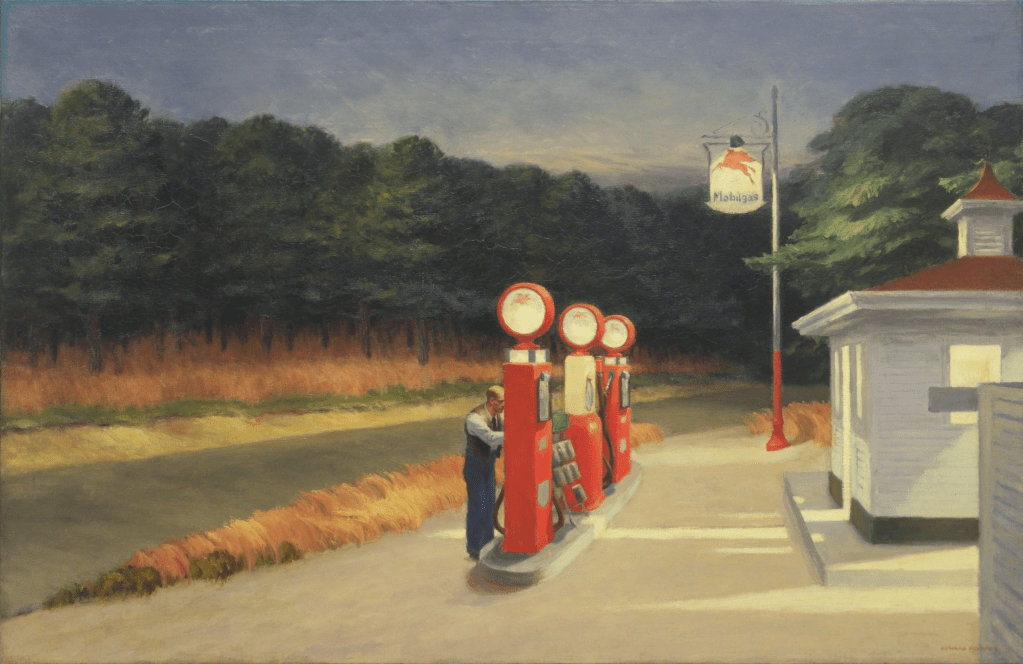
Painted in 1940, Gas stands at the edge of several worlds.
A road enters from the foreground and disappears past a darkening line of trees. On the right, a small gas station glows beneath artificial lights. Three red pumps form an almost ceremonial sequence, and a lone attendant bends toward his work. The sky still holds the fading light of day, but night is advancing. Nature, commerce, machinery, and human labor meet in a scene that appears both ordinary and strangely momentous.
The Museum of Modern Art notes that Hopper created the station from several examples he had seen rather than reproducing a single identifiable location. That compositing is crucial. Gas is not the portrait of one business. It is the memory of an American type: the filling station on the country road, a modest outpost built to serve a nation learning to understand itself through movement.
By the late 1930s, the United States was already crossed by a network of paved two-lane highways, even before the postwar Interstate System transformed the country on a much larger scale. The Federal Highway Administration’s history describes a road network increasingly inadequate for modern traffic and an era already imagining the superhighways to come. The gas station belonged to this new geography. It was a place of fuel, work, commerce, direction, and temporary human contact.
Yet no car appears in Hopper’s painting.
That absence changes everything. A structure designed entirely for motion is shown at rest. The attendant seems to prepare for a traveler who has not arrived, or to complete some small task after one has gone. The road invites us forward, but it disappears into darkness. The lights offer reassurance, yet their circle is limited. Beyond them, the forest remains impenetrable.
It would be easy to call the scene lonely, and it is. But there is also dignity in the attendant’s concentration and comfort in the station’s glow. The place is isolated, but it has been tended. Human beings have placed light at the edge of darkness and created a temporary shelter along the road.
For me, Gas offers an image of American mobility stripped of its usual mythology. There is no open-road exhilaration, no gleaming automobile, no family journey, no heroic arrival in the West. The promise of movement survives only in the curve of the road. Hopper gives us the infrastructure behind the dream and the solitary worker who makes the dream possible.
It is a quiet correction to the national imagination. Every story of freedom on the highway depends upon places of pause, labor, maintenance, and waiting.
IV. Nighthawks: Together, Yet Apart
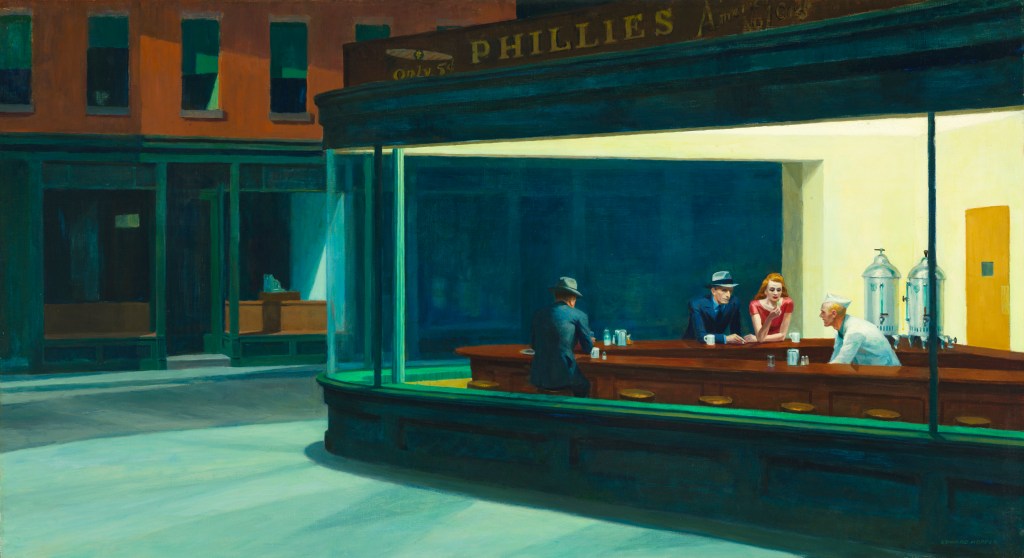
Two years after Gas, Hopper painted the work that would become his most famous image. Nighthawks moves from the country road to the city corner, from dusk to night, and from one person to four. Yet the emotional distance between its figures may be even greater.
The diner is brilliantly illuminated. Its long glass window wraps around the corner, displaying the interior almost like a stage. Three customers sit at the counter while a server works behind it. A man sits with his back to us. Across the counter, another man and a woman occupy neighboring stools, their hands almost touching. The possibility of connection is everywhere, but certainty is nowhere.
Are the pair intimate, estranged, or merely sharing the same late hour? Is the solitary man listening? Hopper refuses to settle these questions. The painting suggests a story while withholding the information required to complete it.
The glass is again decisive. It seems transparent, but it functions as a wall. We can see into the diner with extraordinary clarity, yet we remain outside in the darkened street. No obvious entrance is visible from our position. The interior looks welcoming and inaccessible at once, a refuge transformed into an enclosure.
Hopper based the painting on a restaurant near the meeting of two streets in Greenwich Village, but the Art Institute of Chicago emphasizes that it is not a literal transcription. The real corner has been distilled into a more universal urban space. That is why Nighthawks belongs to no single city despite being unmistakably New York. It has become the diner we imagine might exist in every large city after midnight.
Painted in 1942, it entered the world just after the United States joined the Second World War. It is tempting to place the diner beneath the shadow of that crisis, and impossible to know how far we should. There are no uniforms, flags, or explicit signs of war. The people inside remain suspended beyond any clear historical narrative.
That absence is itself revealing. History does not cease during private moments. Even in years defined by catastrophe, people drink coffee, work night shifts, and sit beside companions. The chronology of war coexists with innumerable hours in which ordinary life continues.
Hopper once acknowledged that, unconsciously, he was probably painting the loneliness of a large city. Yet Nighthawks is powerful because it distinguishes loneliness from simple physical isolation. No one in the diner is truly alone. The figures share light, furniture, service, and proximity. What they may not share is an interior world.
This is a particularly modern form of solitude. The city gathers strangers into common spaces while allowing each person to remain psychologically elsewhere. It creates encounters without guaranteeing intimacy. In that sense, Nighthawks is not merely a portrait of four lonely individuals. It is a portrait of a social condition: togetherness without communion.
And still, I do not find the painting hopeless. The diner shines against the darkness. Someone remains at work; several people have chosen to enter. If the glass separates us from them, it also makes their shared presence visible. The Art Institute has even revisited Nighthawks as an image of hope, reminding us that the meaning of Hopper’s silence changes with the viewer.
That may be why the painting survives endless reproduction. It does not tell us what loneliness means. It gives us a space in which to recognize our own version of it.
V. Morning Sun: Solitude in Full Light
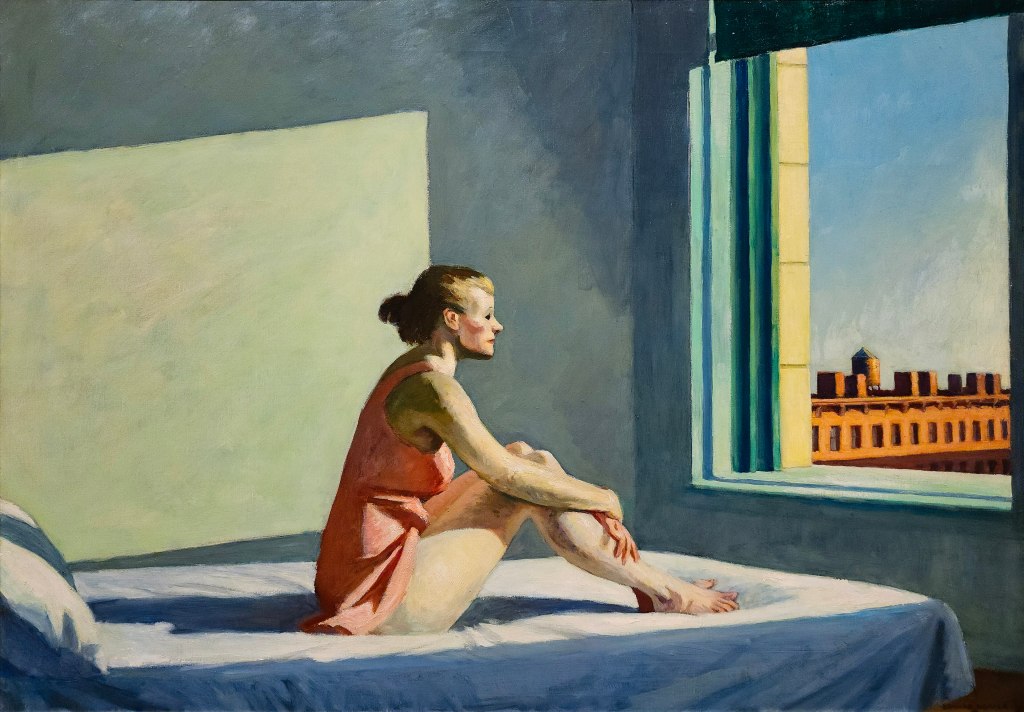
If Nighthawks brought me into Hopper’s work, Morning Sun is the painting that made me want to remain there.
Painted in 1952, it seems at first almost to reverse Nighthawks. Night has become morning. The public diner has become a private bedroom. Four figures have become one. Artificial light has given way to sunlight. Instead of looking through glass from the outside, we are inside the room with a woman looking out.
She sits upright on a neatly made bed, her knees drawn toward her body and her face turned to the window. The sunlight falls directly across her skin and the wall behind her. Outside stands another brick building, its rows of windows offering no landscape and no escape into nature. The city remains close, material, and silent.
The woman was Jo Hopper, who modeled for most of the women in her husband’s paintings. Yet the preparatory studies reveal a gradual transformation. As the Whitney Museum explains, Jo’s recognizable features become progressively less distinct until the figure approaches a generalized “everywoman.” A specific person becomes an open human presence.
This helps explain the painting’s ambiguity. We cannot read her expression with confidence. She may be peaceful, lonely, expectant, tired, or lost in thought. Perhaps she has just awakened; perhaps she has been sitting there for a long time. Perhaps the act of looking is all that matters.
The Columbus Museum of Art presents the central question beautifully: does the painting communicate calm and peace, or overwhelming isolation? Hopper does not force a choice. The sunlight can feel warm, but it is also exposing. The room can feel protective, but also confined. The woman’s solitude may be chosen, endured, or simply inhabited.
This is why Morning Sun now affects me more deeply than Nighthawks. The earlier painting makes loneliness visible through architecture and social distance. Morning Sun makes solitude impossible to define.
There is only a person, a room, a window, and the beginning of a day. Yet the scene contains an entire field of possibility. She may rise and enter the city; she may remain where she is. The future exists, but Hopper leaves it outside the frame.
Historically, the painting belongs to postwar America, a period often remembered through prosperity, suburban expansion, consumer abundance, and national confidence. Hopper gives us none of those familiar symbols. He offers instead a private interior and a solitary woman facing another urban façade. This does not refute the public story of the 1950s. It reveals what such stories leave out.
Economic growth does not abolish interior uncertainty, and collective confidence does not determine the mood of every morning. The history of a nation is larger than the emotional lives of its citizens, but never entirely separate from them.
In Morning Sun, light becomes the connection between the individual and the wider world. The woman does not touch the city, but the morning reaches her. That distinction matters. She is separate without being wholly cut off. Alone, but not necessarily abandoned.
VI. The Silent History of America
Taken together, these three paintings form a small geography of modern American life.
In Gas, the road promises movement while the attendant remains at his station. In Nighthawks, the city brings people together while leaving their inner lives apart. In Morning Sun, the window opens the room to daylight while preserving the boundary between the woman and the city beyond it.
Road, glass, window. Dusk, night, morning. One worker, four figures, one woman. Each painting is organized around contact that stops just short of connection.
This is why “the painter of loneliness,” though understandable, feels insufficient as a description of Hopper. Loneliness is one response to his work, but not its only subject. He also paints waiting, attention, privacy, stillness, vulnerability, and the ambiguous freedom of being left alone. His silences can be oppressive, but they can also create room to think.
Nor should we turn every empty street into a political allegory. Hopper’s paintings retain their force because they do not tell the viewer what to feel. As the painter Charles Burchfield observed in a comment preserved by MoMA, Hopper’s presentation of the American scene does not insist upon the spectator’s response. The viewer must complete the encounter.
Yet refusing to force politics onto Hopper does not remove him from American history. On the contrary, it allows us to see the kind of historical witness he actually offers. His paintings preserve no official chronology. They record structures of feeling: what it might mean to live among strangers, to cross a changing landscape, to occupy a rented room, to work at the edge of night, or to confront the day through a window.
History is not only what happens in public. It is also the accumulation of private hours lived inside the worlds that public events create.
The America of Hopper is recognizably modern because its people are surrounded by systems larger than themselves: cities, roads, commerce, work, transport, architecture. These systems produce freedom and distance at the same time. The road allows movement but leads into darkness. The city permits encounter but cannot guarantee belonging. The window admits light but does not dissolve the wall.
There is something deeply American in this tension. The United States has long celebrated the individual as mobile, self-reliant, and free to begin again. Hopper does not reject that ideal. He asks, quietly and perhaps unintentionally, what it feels like from inside the individual.
Freedom can resemble openness. It can also resemble exposure. Mobility can mean possibility. It can also mean transience. Privacy can protect the self. It can also leave the self alone with its own silence.
Hopper never resolves these contradictions for us. He is neither a celebrant of modern America nor a simple critic of its alienation. He paints the country with affection, unease, and extraordinary patience. His streets unsettle us because they are plausible. We feel that we have passed these places before without noticing them.
That recognition returns me to my own unexpected journey toward his work. I did not leave behind my love of classicism or the Italian Renaissance when I began reading about Hopper. He reminded me that a great composition does more than arrange bodies and buildings: it creates a way of seeing human beings in relation to the world around them.
The Renaissance painters I love often place the individual within an order that can be interpreted. Hopper places the individual within a world that remains open. His light does not deliver an answer. It makes the question visible.
I first returned to him through Nighthawks because it transformed loneliness into an unforgettable public image. I stayed because of Morning Sun, where solitude becomes quieter, more intimate, and less certain. And through Gas, I began to understand that the same tension extends beyond the human figure into the American landscape itself: light against darkness, shelter against distance, stillness beside the road.
Hopper did not paint the America of speeches, headlines, or national ceremonies. He painted what remained after the noise had faded: the counter at midnight, the station at dusk, the room at morning. These are not the places where history usually announces itself. They are the places where people live with its consequences, often without words.
I came to Hopper late, by returning to an image I thought I already knew. Perhaps that is fitting. His paintings are full of delayed encounters: figures who have arrived somewhere, paused, and not yet moved on. They ask us to do the same.
To stop. To look. To allow the light, the architecture, and the silenceto work upon us.
And, for a moment, to enter the quiet history of America.


Leave a comment