
Author’s Note
This essay is, at heart, a reflection on how a television series led me to a poet, and how that poet, in turn, led me back to one of the deepest questions in American history: not only how a democracy is governed, but how it is felt.
I did not discover Walt Whitman in a university seminar, or in one of those solemn literary contexts where a great writer arrives already covered in reverence. I discovered him in a scene from Taylor Sheridan’s Western series 1923. Alexandra, portrayed with remarkable force and vulnerability by Julia Schlaepfer, is exhausted, humiliated, and tested at Ellis Island. Asked to read, she reaches for Whitman: not as ornament, but as defiance. The words, as the episode presents them, are a composite, but their force is unmistakable, to be the ruler of life, not a slave; to let nothing exterior take command; to dismiss whatever insults the soul. In that moment, Whitman did not sound like a monument from the American canon. He sounded alive. He sounded useful. He sounded like someone speaking for dignity under pressure.
That matters to me because it fits the deeper pattern of my own relationship with America. I have often approached the United States not first through institutions, but through stories. As a Belgian historian, I came to America partly through distance, partly through fascination, and partly through myth. The West entered my imagination long before many archives did. I knew it through wide landscapes, riders moving toward a horizon, hard moral choices, and the strange combination of violence and freedom that so many western stories carry. That path took me through films, through television, through Red Dead and Yellowstone, through the emotional grammar of the frontier before it led me toward the documentary grammar of history. Whitman arrived, unexpectedly, as part of that same journey.
What surprised me most was not simply that Whitman spoke to the America of the plains, of riders, of labor, of common people and open land. It was that he gave language to something I had been circling for years in my own writing: the idea that democracy is not only a system of rules, but a way of perceiving others and of inhabiting a shared world. Long before I returned seriously to his poetry, I had already become preoccupied with the civic foundations of democracy, the habits, attentions, and moral disciplines without which institutions go hollow. Whitman gave that concern a poetic body.
I. A Poet Found Through a Western
There was something fitting in discovering him through “1923”. A western, even when it is set in the twentieth century, deals almost instinctively in large questions: land, inheritance, movement, danger, memory, survival. It asks who belongs, what freedom costs, and how a person carries dignity when structures of power close in. Those are historical questions, of course. But they are also moral and existential ones. Alexandra’s Whitman scene worked because the words did not come forward as literary display. They came forward as a creed of inward freedom.
That sent me into the poems themselves. I began with the more recognizable pieces, then moved toward shorter and quieter ones, then outward again into stranger territory. What I found was not a poet who argued in the ordinary sense. Whitman does not usually persuade by syllogism. He places the reader somewhere: on a deck after catastrophe, in a field, beneath the stars, beside a spider, at the edge of the sea. The insight comes afterward. The poem is not first a thesis. It is first an experience.
That distinction is important. We live in a time saturated with argument and impoverished in attention. Opinions arrive instantly. Algorithms reward reaction. Political language is increasingly functional, tactical, or tribal. Whitman belongs to another register altogether. He slows perception down. He asks us to hear, to look, to enter, to dwell. In a democracy, that is not a luxury.
II. Hearing America
| I Hear America Singing | Poetry Foundation |
| O Captain! My Captain! | Poetry Foundation |
The first Whitman poem that made this plain to me was “I Hear America Singing.” It is so often anthologized that one can almost miss its freshness. Yet the poem remains radical in its simplicity. “The varied carols I hear,” Whitman writes, and then he names carpenters, masons, boatmen, shoemakers, wood-cutters, mothers, wives, girls sewing or washing. “Each singing what belongs to her, and to none else.” The force of the poem lies in that phrase: not sameness, but distinctness; not democracy as uniformity, but democracy as legitimate plurality. The nation appears not as abstraction, and not as machinery, but as a chorus of ordinary work.
What moved me there was not merely the praise of labor. It was the discipline of attention. Whitman listens before he proclaims. He hears America not at the level of ideology but at the level of human sound. This matters a great deal now. Much of our democratic crisis seems to me to involve not only disagreement, which is normal, but a deeper inability to hear one another at all. The common world breaks down first in perception. Citizens stop appearing to one another as fellow participants in a shared venture and begin to appear as caricatures, enemies, or noise. Whitman’s poem imagines the opposite condition: a republic in which difference is audible without becoming disintegration.
If “I Hear America Singing” offers democracy as chorus, “O Captain! My Captain!” offers it as grief. The poem is more conventional than most Whitman, and perhaps precisely for that reason it worked so broadly. The “fearful trip” is over. The ship has “weather’d every rack.” The prize is won. And yet the Captain lies “fallen cold and dead.” I had known the poem in school-level outline, as everyone does, but returning to it after reading the others, I felt something different. It is not only an elegy for Lincoln. It is an image of the republic as a shared vessel whose victories do not erase its wounds. A people may arrive safely at harbor and still discover that the cost of arrival is written in loss.
That, too, feels relevant. Democracies do not survive by celebration alone. They survive partly by shared mourning, by the ability to remember sacrifice without turning memory into spectacle, to acknowledge losses that belong to the whole, and to understand that political life always contains something tragic. Whitman knew this after the Civil War with an intimacy few writers could match. What he offered was not sentimentality, but civic grief held in public language.
And behind both poems is a larger Whitmanian conviction that comes into focus even more strongly in Democratic Vistas: democracy cannot be reduced to elections or party labels. He asks, famously, whether democracy is “only for elections,” and answers that it must flower “in manners,” in the “highest forms of interaction” between people and in their beliefs. That sentence has stayed with me because it names the very dimension of democratic life that our age most often neglects. If democracy lives only at the ballot box and nowhere else, it will not live long.
III. The Prairie as Democratic Space
| The Prairie-Grass Dividing | Walt Whitman Archive |
| Night on the Prairies | Walt Whitman Archive |
| A Farm Picture | Walt Whitman Archive |
| A Clear Midnight | Walt Whitman Archive |
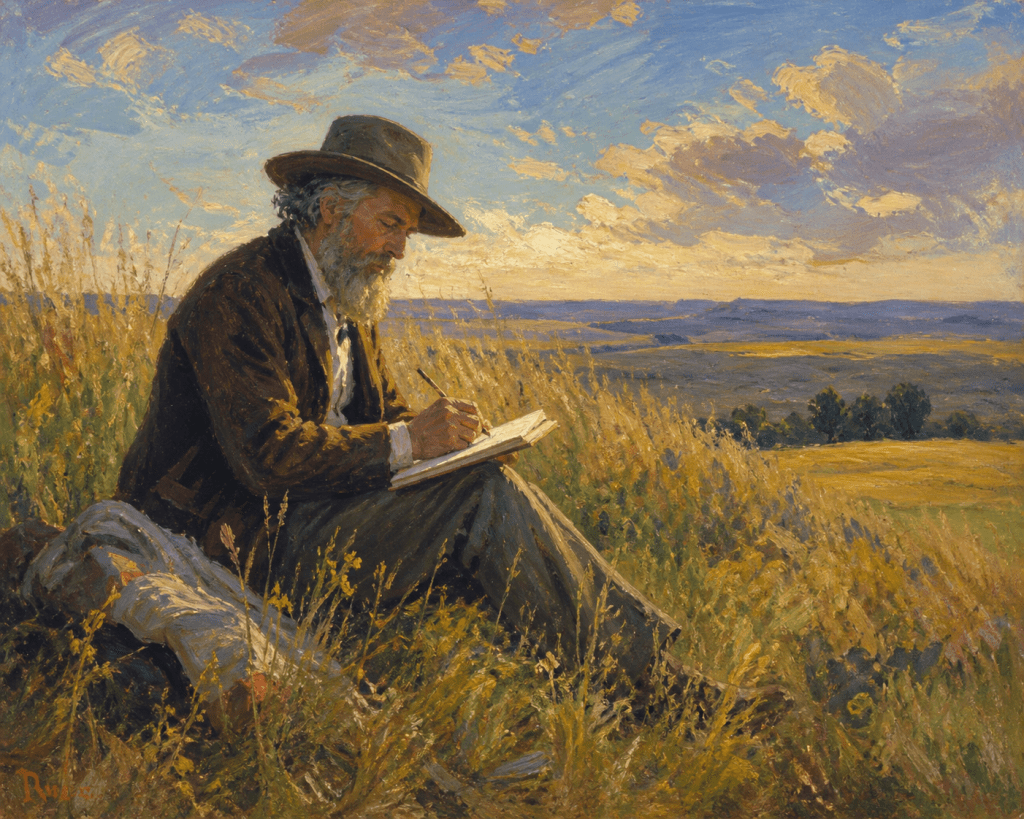
If the first poems taught me to hear Whitman, the prairie poems taught me to inhabit him. This is where the encounter became more personal. I have long been drawn to the interior spaces of America, the grasslands, the ranches, the moving horizon, the visual and moral scale of the West. That attraction began in myth, as many deep historical attachments do. But Whitman gave it another register. In “The Prairie-Grass Dividing,” the landscape is not a mere setting. It is a form of character. He wants “the spiritual corresponding” to the grass; he celebrates “the open atmosphere, coarse, sunlit, fresh, nutritious”; he invokes “Those of inland America.” The prairie becomes a school of bearing: erect, free-moving, audacious, unoverawed by rank.
What strikes me here is that Whitman’s democracy is spatial before it is institutional. It needs room. It needs an open horizon. It imagines persons who stand upright because they are not spiritually bent. The famous line about looking carelessly in the faces of presidents and governors is not mere swagger. It is a democratic anthropology. The free citizen is not servile. He is neither dazzled by office nor reduced by hierarchy.
This is part of why those poems echoed so strongly with me. They connected almost instinctively with the western stories that had shaped me earlier, but they also refined them. In film or television or games, the open land can become a stage for conquest or violence or self-invention. In Whitman, it becomes something quieter and, in an odd way, more demanding. Space is not there for domination. It is there for proportion. It reminds the self that freedom is large, but that the self is not the measure of all things. The prairie enlarges, but it also humbles.
That is perhaps most evident in “Night on the Prairies.” It begins with the fire burning low and the emigrants asleep. Then the speaker walks alone and looks at the stars, which he thinks he has “never realized before.” Suddenly the world breaks open. “Now I absorb immortality and peace.” “I was thinking this globe enough,” he says, “till there sprang out so noiseless around me myriads of other globes.” This is one of Whitman’s great revelations: the open interior of America becomes a threshold to cosmic scale. The prairie gives not only freedom, but metaphysical sobriety.
I understood immediately why that poem stayed with me. It contains a feeling I have often sought in American landscapes and in the stories that lead toward them: solitude without loneliness, vastness without annihilation, calm without emptiness. The self is made smaller, but not degraded. It is placed, not erased. In a republic, that may matter more than we think. Much democratic life depends on proportion, on not confusing one’s own indignation with the universe, on not mistaking the immediacy of one’s own feed or tribe or faction for the whole field of reality.
Some of Whitman’s shorter poems intensified this lesson by going almost to the edge of silence. “A Farm Picture” is barely more than an image: “the ample open door of the peaceful country barn,” a sunlit pasture, haze, distance, the horizon fading away. When I read it, what I felt was not nostalgia, but presence. I was there in the picture. The poem did not tell me what to think. It simply removed every obstacle to attention. In that sense, it worked almost like a haiku, though without the formal discipline of haiku. It offered immersion rather than interpretation.
“A Clear Midnight” does something similar in an even purer form. “This is thy hour O Soul,” Whitman writes, “Away from books, away from art,” and suddenly we are beyond discussion, beyond instruction, beyond the day’s lessons and performances. Night, sleep, death, the stars. What matters there is not conclusion, but exposure, the soul set free from clutter and placed before what is ultimate. I have come to think that this is one of Whitman’s deepest civic lessons. A democracy exhausted by endless rhetoric may need, at times, not more argument but more reality. More world. More patience. More contact with what cannot be reduced to messaging.
IV. The Spider and the Writer
| A Noiseless Patient Spider | Poetry Foundation |
If one Whitman poem reflected me most directly, it was “A Noiseless Patient Spider.” Perhaps that is inevitable for anyone who writes publicly and wonders what writing is really for. The image is plain enough: the spider, isolated on a little promontory, launches “filament, filament, filament” into the surrounding vastness. Then the analogy turns inward: “And you O my soul…” until finally comes the line that stayed with me long after reading it: “Till the gossamer thread you fling catch somewhere.”
I recognized something of my own activity there, not because writing a blog and spinning a web are somehow equivalent in any grand sense, but because the emotional structure is similar. One writes outward. One tests connections. One sends thoughts into a space one cannot fully see. Sometimes the thread catches; sometimes it disappears. If the age is fragmented, one writes anyway. If attention is scarce, one writes anyway. If the public square feels less like a square than a hall of mirrors, one still tries to project something clear, human, and durable across the void.
That mattered to me because so much of my own writing about democracy has emerged from a sense that public language is failing. We live amid polarization, yes, but also amid something subtler and perhaps more dangerous: a loss of shared perception. Citizens not only disagree; they very often no longer stand in the same world. They do not read the same signs, trust the same institutions, or answer to the same standards of evidence and responsibility. The result is not only conflict. It is civic loneliness. It is a republic in which more and more people speak without hearing and hear without recognizing.
Whitman’s spider does not solve that condition. It does something smaller and perhaps more honorable. It keeps reaching. It accepts the “vacant vast” without surrendering to it. It treats connection as difficult, patient work. In that sense, the poem gives me a model not only for writing, but for civic attention itself. To be a citizen in a broken public culture may mean continuing to cast fragile threads toward others without certainty of reply. It may mean refusing both despair and noise.
V. Whitman and Tocqueville
At this point another figure enters my reading almost inevitably. As a European looking at America, I have long felt his presence nearby. Tocqueville helped teach me how to analyze democracy, its institutions, its habits, its local structures, its dangers. He understood associations, newspapers, majority power, civic restlessness, and the fragility of liberty under democratic conditions. For anyone trying to think seriously about American public life from this side of the Atlantic, he remains indispensable.
But Whitman gave me something Tocqueville could not. Tocqueville shows democracy from the outside, through observation sharpened into political intelligence. Whitman attempts something like the inverse. He wants to render democracy from within, as texture, rhythm, visibility, song, bodily bearing, emotional weather. Tocqueville teaches us how a democracy functions; Whitman teaches us how it feels when it is alive, and, by implication, what is missing when it is not.
For that reason I do not see them as rivals, but as complements. Tocqueville diagnoses the visible forms of democratic life; Whitman dramatizes the interior habits without which those forms lose meaning. Tocqueville asks whether citizens associate, deliberate, and restrain power. Whitman asks whether they hear each other, whether they see dignity in common labor, whether they can enter a farm, a prairie, a deck, a midnight sky, a grieving shore, and still feel that these scenes belong to a world they share.
That distinction matters when democracies enter periods of exhaustion. Diagnosis alone, however necessary, becomes insufficient. One can chart institutional decay with great precision and still fail to regenerate civic life. Whitman does not offer a program in the usual sense. What he offers is prior even to program: a democratic imagination, a way of sensing that other people and ordinary places possess significance. That is not sentimentality. It is groundwork.
VI. Learning to Hear Again
| Out of the Cradle Endlessly Rocking | Poetry Foundation |
This is why I have come to think that Whitman belongs directly inside our contemporary democratic crisis, even if he does not belong there in the usual media-driven way. He is not useful because he can be turned into a slogan. He is useful because he resists slogans. He refuses to flatten America into either purity or condemnation. He hears its plurality. He grieves its wounds. He places it in space and among stars. He asks the soul to emerge “Away from books, away from art,” which is to say: away from secondhand posture, away from performance, toward some more primary encounter with reality.
He also understands that democratic life must include sorrow. “Out of the Cradle Endlessly Rocking” may seem, at first glance, far removed from politics. It is about birds, sea, yearning, loss, awakening. Yet it contains one of Whitman’s deepest truths: song is born not only from joy, but from grief. The speaker becomes “A man, yet by these tears a little boy again,” and in that return to vulnerability language itself is transformed. Whitman calls himself the “chanter of pains and joys, uniter of here and hereafter.” That phrase could serve, in another register, as a democratic vocation as well. A republic cannot be sustained by utility alone. It must find forms capable of holding memory, tenderness, and mortality.
If I asked, then, what practical civic implication I take from reading Whitman now, it would not be a legislative recommendation or a campaign strategy. It would be simpler, and perhaps more difficult. Learn to hear again. Hear the ordinary voice before the amplified one. Hear the person before the label. Hear labor, place, and grief before propaganda. Recover some spaces where perception is not wholly colonized by speed, outrage, and algorithmic reward. This is not a substitute for institutional reform. It is part of the cultural soil without which reform cannot hold.
Whitman does not ask citizens to agree about everything. He asks something subtler and more foundational: that they remain capable of granting reality to one another. In “I Hear America Singing,” each sings what belongs to him or her and to none else. The point is not to erase distinctness into a single note. The point is to inhabit a common composition. A democracy begins to die when its citizens no longer hear a composition at all, when every sound is interpreted only as threat, manipulation, or intrusion.
That is why I remain grateful for the strange path by which I found this poet. A scene from “1923” sent me toward Whitman. Whitman, in turn, sent me back toward America with different ears. He did not solve the country for me. He did something better. He made me pay attention. He reminded me that the life of a republic is not only argued in courts, elections, and constitutions; it is also lived in songs, in fields, in work, in grief, in silence, in the calm of a barn door looking onto open land, in the patient thread cast outward by a solitary mind hoping to connect.
In an age of democratic fatigue, that may sound modest. I do not believe it is. Before a society can deliberate well, it must perceive well. Before it can repair institutions, it must recover some shared sense of the world those institutions are meant to serve. Whitman’s poetry is not a policy manual. It is a training in democratic feeling. It teaches the reader to dwell, to notice, to scale the self properly, to respect common life, and to send words outward not as weapons first, but as bridges.
I found him late, and by an indirect road. But perhaps that is fitting. America itself often comes to us indirectly, through stories, landscapes, myths, disappointments, songs. What matters is what happens after the encounter. In my case, Whitman did not simply add another great name to a reading list. He sharpened a conviction I had already begun to form: that democracy cannot survive on procedure alone. It must also be heard, felt, and practiced in the daily discipline of attention. And that, perhaps, is where learning to repair it begins.


Leave a Reply