
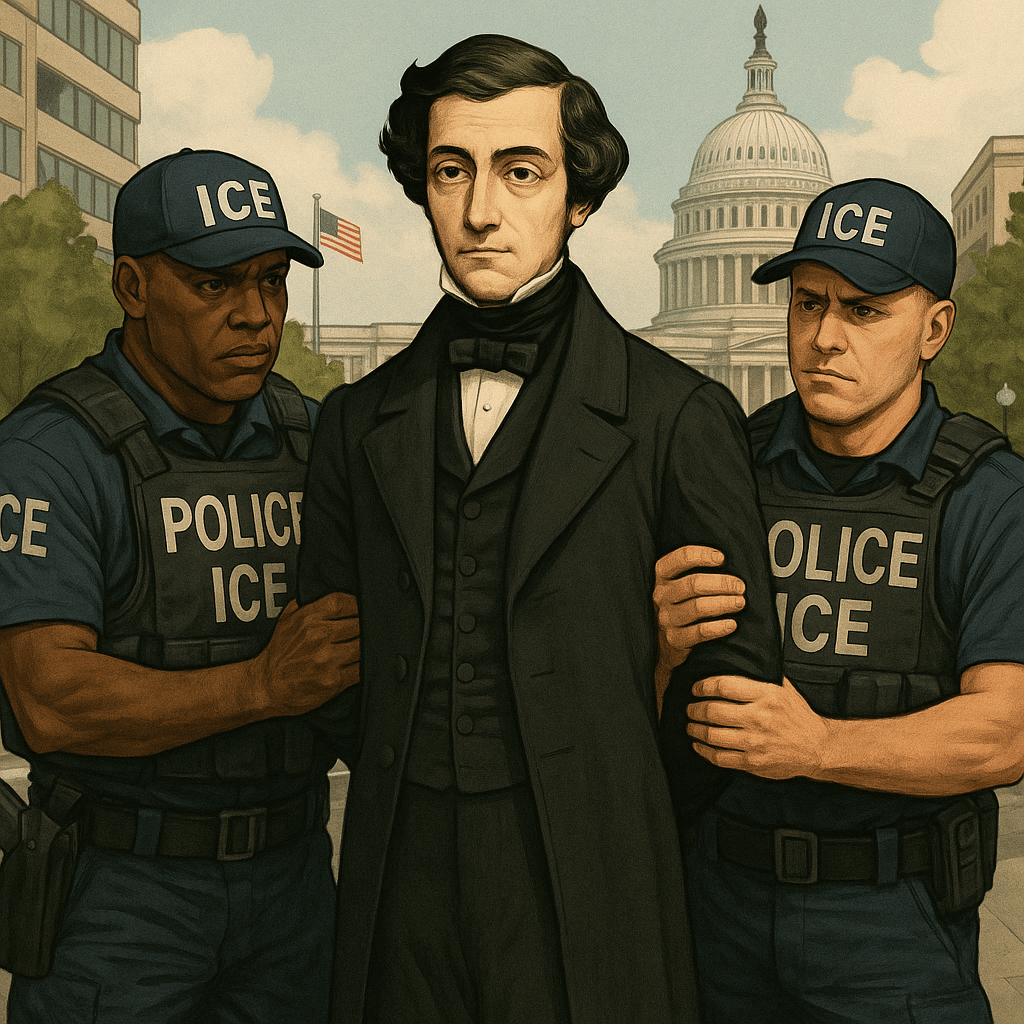
Alexis de Tocqueville’s Democracy in America (1835–40) was the product of a nine-month journey through early Republic America. A French aristocrat sent initially to study prisons, Tocqueville found himself “seeking the image of democracy itself”. He observed that Americans had embraced equality – the old aristocracy was vanishing and “the social and economic conditions of men had become more equal”. He saw this equality as a “providential fact” and believed it compelled a new “political science” to guide democracy. From this vantage he spelled out both the promise and peril of American-style democracy. He lauded the energy and initiative of ordinary citizens, the vitality of local communities and associations, and the power of a free press – “only a newspaper can put the same thought at the same time before a thousand readers,” he wrote, arguing that newspapers “maintain civilization” by binding people together. He also warned of democracy’s dark side: that a militant majority might oppress minorities, that extreme individualism and restlessness could erode civic virtue, and that a subtly authoritarian “soft despotism” could arise even under free institutions. These insights – equality and liberty, civic engagement, and the risks of majoritarian tyranny – were distilled from Tocqueville’s America, but they echo strikingly in today’s political moment.
In fact, many Americans themselves seem to fear their system is in peril. A January 2025 Gallup poll found only 34% of U.S. adults satisfied with “the way democracy is working” in America, a figure that has hovered near historic lows. Partisan bitterness runs high: in the months after Trump’s 2024 return to the White House, both parties registered record distrust of rivals’ intentions and institutions. Voices on the left lament gerrymanders and voting suppression, while voices on the right complain that coastal elites and deep-state judges defy the will of the people. Even conservative commentators remind us “the United States was never intended to be a pure democracy,” couching institutions like the Electoral College and Senate as bulwarks against “the pernicious effects of too much democracy”. Tocqueville understood this tension: the Framers feared majorities might “shoot into a monarchy, or some other form of dictatorship”, just as they provided checks like a bicameral legislature and independent courts. As one Harvard scholar notes, Tocqueville’s “greatest danger… was that public opinion would become an all-powerful force, and that the majority could tyrannize unpopular minorities”. In many ways, Tocqueville anticipated what the famous “tyranny of the majority” warning would mean: without strong civic habits and constitutional safeguards, even well-intentioned democracy can devour dissent and diversity.
Yet Tocqueville was no pessimist. He famously wrote that America’s greatness lay “not in being more enlightened than any other nation, but rather in her ability to repair her faults”. The 1830s Republic was far from perfect – Tocqueville’s analysis largely ignored slavery, women, and Native peoples – but he believed in the resilience of the American experiment. Reading Tocqueville today, it is that spirit we must recall: civic responsibility, public debate, and a willingness to self-correct.
I. Equality, Associations, and Civic Life
Tocqueville famously identified equality of conditions as the defining feature of American society. Gone (for whites) was the old feudal hierarchy; instead, commerce, voluntary professions, and new political equalities empowered most men to see themselves as political equals. He noted, however, that this material and social leveling bred a subtle restlessness and individualism. Americans might forgo the honors of aristocracy, but they risked “moral, spiritual, [and] artistic” impoverishment in a land of endless strivers. He worried that Americans, focusing on material comfort, could withdraw into private life and become isolated—what he called individualism, a kind of egocentric liberalism divorced from public spirit. To counter that, Tocqueville pointed to something uniquely strong in America: the “abundance of associations” and vibrant local communities. Town halls, civic clubs, religious groups, and print media all knitted people together beyond their private homes. He wrote that free newspapers “maintain civilization” by spreading common ideas quickly and binding distant citizens into a political conversation. In short, robust civil society was Tocqueville’s antidote to lonely self-interest.
In 2025, many of those civic bonds seem frayed. Social media and 24/7 news cycles have replaced the village meeting and neighborhood paper – but with very different effects. Americans now live in information silos as fierce as Tocqueville feared passions could be. Even Barack Obama has warned that social media “are one of the biggest reasons for democracies weakening,” because they trap citizens in echo-chambers and distort reality. (Tocqueville could not have imagined Facebook, but he saw the same impulse: the people’s “passion for equality” becomes “ardent, insatiable, incessant” once it takes hold.) Political debate often turns from reasoned argument to outrage and insult. Citizens report that they share less trust with neighbors or officials than before. Tocqueville’s remedy – stronger civic life and free discussion – feels especially urgent. His stress on free associations reminds us that beyond the Washington power plays, American democracy lives or dies in hometowns, churches, unions and clubs. If Tocqueville were here, he would urge us to rebuild those small networks of self-government that give people a stake in one another’s welfare, so that government is of, by, and crucially for the people, not merely an instrument of a faction.
II. Majority Rule and Minority Rights
A central Tocquevillian theme is the “omnipotence of the majority.” He argued that in the U.S., where all (white) men had equal political standing, a united majority could easily outvote or shame any isolated minority. Laws and norms could align to reflect majority opinion at the expense of dissent. In his words, unchecked public opinion in a democracy risks becoming “an all-powerful force” that can “tyrannize unpopular minorities”. In practice, this meant judges and free press were vital: they could protect minority rights and detain the majority’s fury. Tocqueville believed Americans had so far succeeded in respecting local liberties and an independent judiciary; but he warned that if public passion ran unchecked, one day people might see judges as foreigners to be overcome by popular will.
In mid-2025 we see this tension writ large. President Trump’s public statements and policy moves have repeatedly tested the boundaries of majority power. He has repeatedly assailed judges who block his orders as “left-wing activists,” implying they lack legitimacy. Galston (at Brookings) notes that Trump’s rhetoric invites “the democratic legitimacy of the judiciary” to be undermined, warning darkly that if a “popular majority [is] persuaded to see the courts as illegitimate… the president could defy rulings of the Supreme Court and get away with it”. That scenario would realize James Madison’s worst fear – all power concentrated in one hand – and it recalls Tocqueville’s fear of a majority so free of constraint that it rules by caprice rather than law.
Likewise, Trump’s supporters have pointed to America’s Constitution and federalism as antidotes to tyranny. Some invoke Tocqueville’s appreciation for American institutions when arguing the United States was “never intended to be a pure democracy”. There is truth to that: the Founders did engineer checks (the Senate, Electoral College, federalism) as “essential safeguards” of liberty. Tocqueville himself saw Americans fiercely defend states’ rights, local self-government and jury trials. He praised the decentralization of power, writing that lacking a strong centralized administration helps “temper the tyranny of the majority”. Today, by contrast, we have witnessed federal intervention in traditionally local domains – for example, California’s governor sued when federal troops were sent to quell Los Angeles protests, and a court briefly ordered them withdrawn.
But Tocqueville would caution both sides. If the left fears a strongman and the right fears “mob rule,” he would remind them they are two halves of the same coin. He believed that, over time, the American majority had followed the rule of law even when it disliked a verdict – but that required a civics culture which is now fraying. In 2025, the lines between “majority rule” and the “will of the people” are often drawn by demagogues and algorithms, not by reasoned consensus. Tocqueville urged vigilance: “the great advantage of democracy is that it enables the people to suppress the violent impulses of one another,” he wrote, but “the contrary is also true: democracy incites the people to mobilize for these very purposes”. In other words, democracy can either calm or amplify passions – it depends on us.
III. Crisis and Contention in Trump’s Second Term
In the weeks of June–July 2025, the lines between democracy and autocracy in America have blurred more than usual. Consider some examples. In California, large protest rallies erupted against Trump’s immigration raids, and the president responded by sending Marines and National Guard troops to Los Angeles – on American streets to enforce domestic policy. This was striking: U.S. Marines standing guard at a federal detention center. A federal court even noted that the troop presence was “inflaming tensions”. On June 12–13, as protests continued, a court temporarily barred the Guard, only to have Trump quickly reinstate them on appeal. Mayor Karen Bass of Los Angeles decried the scene as an attack on democracy, and nationwide “No Kings” protests on June 14 warned against turning the U.S. into “a monarchy.” Tocqueville would recognize this as the very struggle over executive power he anticipated: Americans fighting to keep their leaders answerable.
On other fronts, Trump has seized on crisis rhetoric to centralize authority. An influential Heritage Foundation plan known as “Project 2025” lays out sweeping reforms: purging civil service, dissolving agency independence, even invoking the Insurrection Act on domestic issues. In his first six months back in office, Trump’s administration quietly began implementing parts of this agenda (for example, reviving a civil service overhaul, pushing strict immigration enforcement, and rescinding past guidance on health-care protections). Some actions have directly rolled back Biden-era policies on climate and civil rights, trading decades of rulemaking for rapid executive orders. One notable move in early June was the rescission of a 2022 CMS guidance that had required emergency rooms to perform abortions to save women’s lives. The Trump administration quietly claimed the guidance was illegal and withdrew it. This sudden change alarmed medical and rights groups, and Tocqueville, who believed Americans prized local charities and hospitals serving community needs, would surely have been unsettled by government officials calling lifesaving health care a liberty too far.
Even as Trump has expanded executive action, Congress has remained polarized. In early July, legislators forced a tie-breaking Senate vote (via Vice President Vance) to pass a massive budget-and-tax package ironically named the “One Big Beautiful Bill Act.” It substantially extends Trump’s 2017 tax cuts and increases spending – a move that Tocqueville might regard as abdication of fiscal discipline for short-term popularity. Meanwhile, Trump’s disdain for restraints extends to legal checks: he openly mocks judicial review and has signaled willingness to ignore court decisions he dislikes. William Galston warns that Trump’s attacks on judges and demands for “loyalty” from the judiciary threaten to undermine the very legitimacy of checks and balances. In Tocqueville’s terms, if Americans accept the idea that a strong leader can override courts or Congress, they edge toward the “despotism” he dreaded.
On the world stage, America’s democratic example also strains. In June, a sudden regional war broke out when Israel bombed Iran’s nuclear sites. Within days Trump ordered U.S. strikes on Iran’s facilities, then brokered a hasty ceasefire. Here too Tocqueville’s insights are relevant: he admired Americans’ global optimism but cautioned that foreign adventures could distract or overextend the Republic. Trump returned from NATO’s summit at The Hague demanding all allies spend 5% of GDP on defense – reflecting a transactional America rather than a leader by example. In Africa, Trump scored a diplomatic victory: on June 27 he brokered a peace treaty between the Democratic Republic of Congo and Rwanda. He even boasted that as part of the deal “the United States” would get “a lot of the mineral rights” from Congo. Whether motivated by altruism or realpolitik, this deal shows America still exerting global influence – yet its transactional tone underscores a shift from democratic idealism to power politics. Tocqueville once thought American democracy might inspire others; today it more often evokes skepticism abroad. Indeed, indices from 2022–2024 already rated the U.S. as a “flawed” democracy, with declining trust in institutions. If Tocqueville visited now, he would observe that U.S. credibility depends not on military shows but on demonstrating that democracy can meet crises with justice and liberty.
IV. The State of American Democracy: Worth Noting (and Fixing)
All this paints a picture of democracy in conflict. But Tocqueville’s spirit was to diagnose so that one might cure. He insisted that the American success story was self-correcting: the same society that allowed for extremes could also adjust them. As he put it, America’s greatest asset was the ability “to repair her faults”. He would urge us to remember how democracy is supposed to work: not by silencing debate, but by confronting fear with knowledge; not by shutting down newspapers, but by fostering them; not by using the military against civilians, but by respecting civilian institutions. His lessons suggest concrete steps:
- Engage Locally: Tocqueville observed that Americans thrived when they joined voluntary associations and local politics. Even as national discourse is toxic, citizens can rebuild trust by volunteering, teaching civics, and holding town halls. When people feel they have a voice in community life, they resist the temptation to see their fate in the hands of a distant strongman.
- Defend Free Speech and Press: Tocqueville wrote that free newspapers were the “first of the political associations in America”. Today’s media ecosystem is fractured, but supporting journalism – especially local and investigative outlets – is vital. Citizens and leaders alike should heed Tocqueville’s warning that individualism and “anomy” threaten democracy unless a free press counters them. Calling journalists “enemies” or labeling unwanted speech as illegitimate risks the “soft despotism” he described, where the government and media erode the public’s sense of empowerment.
- Uphold Minority Protections: The judiciary exists precisely to guard minority rights against fickle majorities. Tocqueville predicted America’s future would test whether courts remain trusted arbiters. Americans must resist any notion that judicial decisions are illegitimate simply because they thwart a current majority. As one commentator put it in 2025, if a popular majority begins to see judges as “illegitimate,” a leader might flout Supreme Court rulings altogether. Tocqueville would see that as a death knell for self-government. Instead, leaders on all sides should recommit to the idea – Madison’s idea – that law is the will of all people, not just the majority.
- Balance Equality with Liberty: Tocqueville believed that Americans were animated not only by their passion for equality, but by a deep attachment to liberty. Yet liberty, he warned, does not thrive in a vacuum. It requires a citizenry that feels secure in its rights and morally invested in public life. When policies suppress fair dissent or narrow fundamental freedoms under the guise of order, they betray the spirit of democratic self-government. Consider two recent developments: the move to reclassify civil servants so they can be fired for perceived “disloyalty” to the president, and the abrupt revocation—by executive order—of emergency medical protections for women facing life-threatening pregnancies. Both measures sideline deliberation, target vulnerable individuals, and concentrate power in the executive. They echo not the civic pluralism Tocqueville admired, but the creeping administrative despotism he feared—a system in which citizens, deprived of agency and protection, gradually forget the habits of liberty. Today’s Americans champion rights that Tocqueville never imagined—gender equality, racial justice, LGBTQ dignity. But these rights cannot rest solely on bureaucratic enforcement or legal formulas. They must be rooted in a living democratic culture—one that debates openly, corrects itself honestly, and extends solidarity as a civic virtue.
- Learn from History, Not Nostalgia: Tocqueville never idealized the past; he saw history as a teacher. He admired the Founders’ system, but also recognized it must evolve. Today’s republic is different from 1835’s, but its core questions remain: how to govern without tyranny, how to allow change without chaos. Americans must study their history (as Tocqueville did) not to freeze it in amber, but to draw lessons. For instance, Tocqueville noted that even in monarchical France, democracy had real psychological power on people’s minds; similarly, today’s Americans can reclaim the original meaning of “We the People” by active participation, not by passivity or cynicism.
At the same time, we should acknowledge Tocqueville’s own blind spots. He largely overlooked slavery and gave scant attention to race; this was his era’s tragedy. Modern readers rightly reject any simplistic idolization of 19th-century America. But we can still benefit from Tocqueville’s big-picture thinking. He would no doubt be astonished by the speed, scale, and interconnectedness of our world. Yet the heart of his insight remains: democracy does not live in institutions alone, but in the habits, expectations, and shared responsibilities of its citizens.
Conclusion: Democracy’s Next Chapter
Tocqueville wrote that in America “there is almost no political question…that is not resolved sooner or later into a judicial question”. That remark was meant as a compliment to judicial review, but it also hints at a slippery slope: when every political battle ends in court, political energy is drained from popular deliberation. In 2025 this has become obvious: partisan fights over policy often end up before judges, and few trust the courts wholly. If Tocqueville were alive today, he might say that is proof the citizenry has retreated from politics rather than dominated it. He would remind us that the genius of American government is not speed or efficiency, but “checks and balances, [and] deliberate messiness” designed to keep power from concentrating. Efficiency has become an excuse for rule-by-decree, and Tocqueville would not recognize it as democracy.
But he would also not give up hope. As John Shattuck of Harvard’s Kennedy School has noted, Tocqueville believed the United States could endure and even flourish by addressing its flaws. Tocqueville’s final prescription might be as he wrote after 1835: “In America I have seen more than America… I sought the image of democracy itself”. That image includes both light and dark: a nation proud of liberty, yet challenged by the temptations of power. For Americans in 2025, that means recalling why they embraced democracy. It was never a guarantee of perfection, but a promise of self-rule. To keep that promise, Americans must remember Tocqueville’s enduring insight: democracy is not just a system of government, but a way of life – demanding participation, tolerance, and constant renewal.
Read Tocqueville here :
If you’ve never read Democracy in America, or if it’s been a while, I encourage you to return to the original text. Despite its 19th-century prose, Tocqueville’s observations remain startlingly relevant—and even more so in an age where democratic norms are under pressure.
A free, public-domain English edition of the full work (translated by Henry Reeve) is available via Project Gutenberg:
🔗 Read Democracy in America – Project Gutenberg Edition
It’s not just a historical artifact, it’s a mirror.


Leave a Reply