
Author’s Note
This essay is more personal in tone than most of my published work. It is, at heart, a reflection on the stories that shaped me long before I became a historian — and on the strange but powerful ways in which cinema, comics, and video games can open the door to serious historical inquiry.
I chose to publish it here because I believe that the line between cultural memory and historical understanding is not just academically important — it’s profoundly human. Many of us, whether we realize it or not, were first drawn to the past not by footnotes, but by fiction. This article is about honoring that spark, while also interrogating the myths it lit in us. It’s about how we come to care about justice, memory, and truth — sometimes by way of stories that are only partly true.
If you’ve ever been moved by a film, a novel, or a piece of popular culture and felt that it somehow mattered more than mere entertainment, I hope this piece resonates with you. As with everything I write here, it is driven by a belief that history is not just a record of what happened, but a living conversation about who we are, what we remember, and what we still strive to become.
“The film is certainly not a history lesson… but I do hope our efforts to authenticate the people and places we’re dealing with will finally show a side of their legacy… their honor.” —Kevin Costner, Dances with Wolves
In my case, this promise worked like a charm. My passion for history was not ignited by a classroom or a textbook but by the untamed frontier captured on a VHS tape. As a boy in Namur, Belgium, I remember the first time I saw Dances with Wolves: the endless Dakota sky, the thundering buffalo herd, and Lieutenant John Dunbar (Kevin Costner) awkwardly trying to break the Sioux language barrier. I was twelve, and I was mesmerized by the sweeping landscapes and the Lakota spoken on screen. I had never seen Native Americans portrayed with such dignity and depth. That one film, celebrated by critics and Lakota alike for its “sensitive, non-stereotypical portrayals of American Indians”, planted a seed in me.
I. Dances with Wolves and the Call of History
My journey westward (in spirit) began with that Dances with Wolves VHS. I came to it without any scholarly intent, simply drawn by the promise of adventure and something “forgotten” in history. In the film, the lone Union soldier Dunbar earns the Sioux name “Dances With Wolves” when he joins a tribe on the plains. Watching Dunbar and Kicking Bird, Wind in His Hair, and Stands With A Fist slowly become family was an emotional experience. It wasn’t just entertainment; I cared deeply about their fates. It felt revolutionary to see Indigenous characters “portrayed honestly and sympathetically,” as many praised the movie. In Belgium, I had never learned real Sioux history – on screen I was seeing “the grace and inner spirit” of a people usually rendered invisible or cartoonish in popular culture. In short, I was learning to see with fresh eyes.
What struck me most was the film’s blend of myth and reality. Dances with Wolves was a romance on its face – a Hollywood epic. Yet it hinted at something darker: it showed how history (colonialism, war, loss of lands) was devastating for the Lakota way of life. As Costner himself acknowledged, the film “is certainly not a history lesson or an attempt to set the record straight,” but it did reveal a long-forgotten side of the Lakota legacy. Those three hours taught me to care about real people who had been lost to official textbooks. In the end, I understood that the buffalo hunt I saw on screen was not mere escapism, but a spark. A fictional buffalo kill in 1990 ultimately led me, years later, to real archives and libraries. In those moments of wonder, cinema had given me a purpose.
II. Imagining the West : From Blueberry’s Panels to Red Dead’s Plains
My fascination with the West did not stop with Costner. Growing up in Europe, I found the frontier myth everywhere in our pop culture. My Belgian grandparents had a shelf of Blueberry comics by Jean-Michel Charlier and Jean “Moebius” Giraud, and I devoured every volume. Blueberry is a classic Franco-Belgian comic series set in the American West, and it kept the Western adventure alive in Europe. Its artwork – red mesas, smoky saloons, tattered sunsets – was cinematic and vivid. Through those pages I galloped across Arizona deserts and Colorado ridges. I didn’t realize it then, but I was experiencing a dialogue between America and Europe: an American myth filtered through European imagination, sparking the curiosity of a Belgian boy who would later study American history for real.
Books also fueled that imagination. While other kids had action figures, I read Karl May novels about noble Apache brave Winnetou and wise Old Shatterhand. I soaked up Larry McMurtry’s novels and Cormac McCarthy’s tales of the frontier, John Ford’s The Searchers, Sergio Leone’s gunslinger epics, even historical fiction like Fenimore Cooper’s. Each story painted the West in new colors. I learned that the frontier is as much a story we tell about ourselves as it is a place.
As a teenager I explored the myth interactively through video games. In Red Dead Redemption, I rode a virtual horse through open plains and dying frontier towns. The game’s narrative was sobering: it showed the frontier closing in real time – iron fences replacing open range, buffalo herds gone, tribes subdued, lawmen hunting outlaws. It reminded me of a historian’s truth rather than a child’s fantasy. One commentary put it bluntly: “In the Red Dead Redemption games, the West wasn’t won—it was robbed, deceived, and cheated.” This was the anti-Western ethic made playable. Still, the game’s world was lovingly detailed – the wide sky, rushing rivers, and the thrill of a sunset gallop – keeping alive the strange allure of the West. Finishing a session, I often found myself hopping on a computer or in a library the next day, eager to learn the real stories behind what I’d seen. The cycle continued: myth led to reality, story led to history.
III. Yellowstone and the Plural American Dream
Decades after that first viewing of Dances with Wolves, Kevin Costner returned into my life through Yellowstone, the hit TV series where he plays John Dutton, patriarch of a Montana ranch. By this time I was a trained historian, a little jaded, and frankly skeptical. Could a modern western soap opera rekindle that childhood spark? To my surprise, it did — but in a different way. Yellowstone is set in the present day, but it feels like history turned up to eleven. Dutton rules his Montana valley “like a feudal lord”, defending ancestral land against every threat: government regulators, real estate developers, and the neighboring Native reservation. The creator, Taylor Sheridan, has said the show examines “the dark side of the American dream” (matters of power, land, and legacy). Watching it, I saw that the old conflicts of the frontier simply evolved; they never really went away.
What fascinates me most is how Yellowstone reminds us of multiple American dreams colliding. In textbooks we often talk of the American Dream as one grand ideal of prosperity or freedom. But in Yellowstone each group has its own dream. John Dutton’s dream is the freedom to preserve his family ranch on his terms, hardscrabble and sovereign as the open range. Chief Rainwater and the Broken Rock Reservation have a very different dream: to reclaim sovereignty and prosperity for their people, righting historical wrongs. The corporate tycoons and real estate developers in Yellowstone chase yet another dream: unlimited opportunity and profit, to transform the wilderness into convenience. These dreams – ancestral tradition versus restitution versus wealth – crash into each other violently. It’s a microcosm of history: from settlers-versus-native tribes to ranchers-versus-homesteaders, the West has always been a stage for contested visions of America.
At heart, Yellowstone taught me that the “American Dream” was never singular. It was always plural and frequently at odds. In one episode, as scenes of conflict unfolded, I realized: Kevin Costner’s career embodies this mosaic of American dreams. In Field of Dreams he chased baseball’s promise, a story of redemption and intergenerational ties. As Sheriff Elliott Ness in The Untouchables, he fought for law and order – the dream of justice against corruption. Even his roles in political thrillers like JFK and Thirteen Days touched on the dream of truth and honorable leadership. And through all his Westerns (from Wyatt Earp to Open Range to Hatfields & McCoys to Yellowstone), he kept circling back to that romantic frontier ideal of carving out a free life on open land. A Los Angeles Times profile called Costner’s films “Americana touchstones,” each a different facet of America’s mythic self-image. These are American dreams in the plural – “fleeting, contradictory,” as one article put it.
As a historian, I find it poetic: in Yellowstone, Dutton defends his dream (the ranch) against others’ dreams (the casino, the ski resort). The show takes no easy moral stance – Dutton is far from a flawless hero – yet it makes clear that the conflicts of the 19th century live on in new forms. It pulls me from fantasy into the real world again: when I watch these battles over land and power, I’m compelled to dig into current issues like Native American sovereignty, land rights, and rural economics. Once again, Costner has drawn me from on-screen drama into real-world reflection. The frontier’s fate is not just a story; it’s a living question — one that keeps me reading, reflecting, and caring.
IV. Between Myth and Reality: Values Shaped and Lessons Learned
Looking back, I’m amazed how much of my intellectual and moral formation was catalyzed by stories and a figure I’d never meet in person. Kevin Costner’s films – and the Western genre more broadly – planted seeds in me that grew into enduring values. The most obvious is justice. Westerns are morality plays at their core: the lone hero rides in to face the oppressor, and the community finds resolution. As a child I instinctively rooted for justice for the Lakota in Dances with Wolves – it felt right that the dispossessing soldiers should be stopped. In Open Range, I cheered when Costner’s rancher character stood up to a corrupt baron, pistol drawn, delivering frontier justice. Those visceral stories taught me to abhor injustice and to stand up for what’s right, even if it means standing alone (or with just a trusty few by your side).
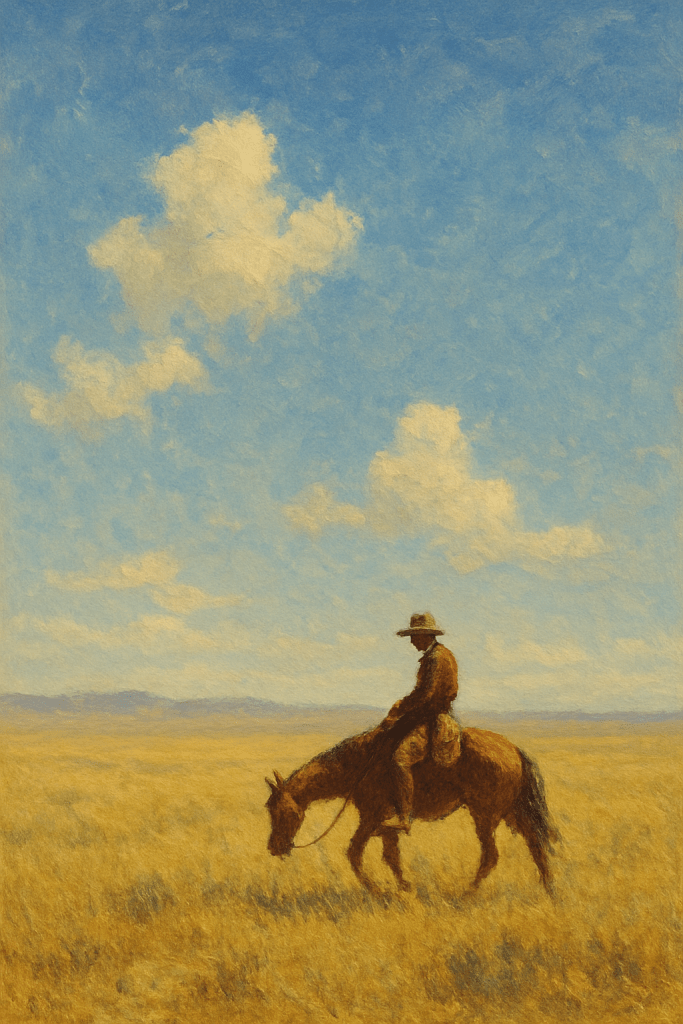
Then there’s freedom. The image of a cowboy silhouetted against a vast sky speaks to a deep longing. The American frontier myth was all about the ability to reinvent oneself and roam unburdened by old hierarchies. As a child, I believed somewhere beyond the horizon lay a place where one could be truly free. Of course, that idea has its paradox: the freedom of some in the West often came at the oppression of others. As an adult historian I recognize that contradiction – but the feeling lodged in my heart early: I treasure liberty, autonomy, and the courage to break away from constraints. That childhood fantasy drove me to study stories of peoples fighting for freedom in reality: the civil rights movement, anti-colonial struggles, modern indigenous rights. Those narratives of seeking autonomy felt like the same spirit I saw in the movies and games about frontiers.
Dignity is another lesson I absorbed from cinema. Costner’s movies often highlight the dignity of characters whom history has marginalized. In Field of Dreams, he honors aging ballplayers and father figures; in Dances with Wolves, he honored the humanity of Lakota culture. What I internalized was this: every person and society has its own richness and worth, even if history has tried to ignore them. Watching those Lakota families around the campfire, and later learning about the tragedies they endured, instilled in me a duty: to remember these peoples, to acknowledge their stories and not let them be forgotten or distorted. It’s the historian’s oath, rooted in empathy.
Perhaps most fundamentally, I learned that memory matters. My guiding conviction as a historian is that we owe it to those who came before to remember their lives, struggles, and dreams. Memory is not frivolous nostalgia; it’s our collective conscience. As one scholar has put it, behind the surface narratives of justification, “real or symbolic wounds are stored in the archives of cultural memory”. Indeed, my journey was all about moving memory from the archive to the present: I carried that passion from those movies and games – from myth to fact. In archives and books, I dug into treaties, census records, oral histories. With each new fact, the mythic story from childhood gained context.
I don’t view that childhood enchantment as a mistake. On the contrary: without the emotional connection forged by those stories, I might never have pursued the truths behind them. The myths led me to the facts; the legends led me to history. Even now, I don’t reject the myths – I engage with them, question them, sometimes love them for what they are while knowing what they are not. As historian Richard Slotkin reminds us, “the myth of the frontier is our oldest myth” in America. By that he means that American culture has long told itself stories of expansion, conflict, and renewal on the frontier. Those stories helped shape the American identity that fascinated me from afar. I fell in love with that mythic version of the West as a kid, and the values it impressed on me are very real: justice, freedom, dignity, remembrance.
Yet I also grew up recognizing the limits of that myth. Films were not accurate history – they were never meant to be. Turner’s famous thesis even declared the frontier “has gone, and with its going has closed the first period of American history.” But scholars now stress Turner was half right: the frontier as open land did vanish, but its legacies live on. The census bureau itself admitted the obituary for the frontier was premature, reinstating a frontier line in 1900. And as Red Dead Redemption II illustrates, the West wasn’t so much “won” as robbed and reshaped. The real story of the West includes those scars – and not just for white pioneers, but for all people who lived there. Recognizing that complexity was my education’s gift.
V. Myth, Memory, and My Purpose
Reflecting on Costner’s influence, I see clearly that the America I fell in love with as a child was, in many ways, an imaginary one. My frontier was partly Hollywood, partly literary (Fenimore Cooper, the Belgian comics of Giraud), and largely my own yearning. In reality, the Plains were home to rich civilizations long before the first cavalrymen rode through. But I don’t regret being a romantic kid. Engaging with that imagined America led me to discover the real one – a place more fascinating and more tragic than any myth. The true stories of the Lakota and other tribes, the complex history of the West, and the ongoing saga of the American experiment are things I now study with passion and care.
Now, when I watch a new Western or read an old one, I do so as both fan and critic. I appreciate the ideals these stories convey – a yearning for justice, freedom, and dignity. Costner’s films resonated because they conveyed ideals, even if imperfectly. Importantly, they conveyed them to me at a formative age, sparking a desire to learn more. No, these stories were not true history – but they “sparked something accurate in me: a desire to learn, to question, and to uphold certain values.” In the great paradox of my life, a fictional buffalo hunt led me to a very real pursuit of truth in archives and libraries.
As a historian today, I strive to honor both the myth and the reality. I appreciate the power of the American dreams we’ve told on screen – because they do carry meaning, even if not the whole truth. They carried meaning for a kid in Namur who felt a calling in those stories. They carry meaning for the adult I’ve become, who understands that myths can inspire us even as we commit to digging deeper. In the end, I am thankful for Costner’s unwitting mentorship. He cared about America’s stories – both proud and shameful – and put them on screen. My West may have been a make-believe frontier, but the values and curiosities it inspired are very real. Justice. Freedom. Dignity. Memory. These are the treasures I carry out into the real world.
Kevin Costner’s characters are not literally my teachers, but the stories they told became a kind of classroom for me. They taught me that the past can be alive and urgent, that history is not just names and dates but people’s dreams and sufferings. In the mythology of the American nation, in the courage of my fellow historians, and in my own voice, I keep asking questions and seeking answers. And that, I believe, is part of the historian’s calling: to care about the myths not for what they promise, but for what they reveal — and to keep questioning them, so that the deeper lessons of history are never lost.
Welcome to the conversation.

 USPH
USPH 
Leave a comment