
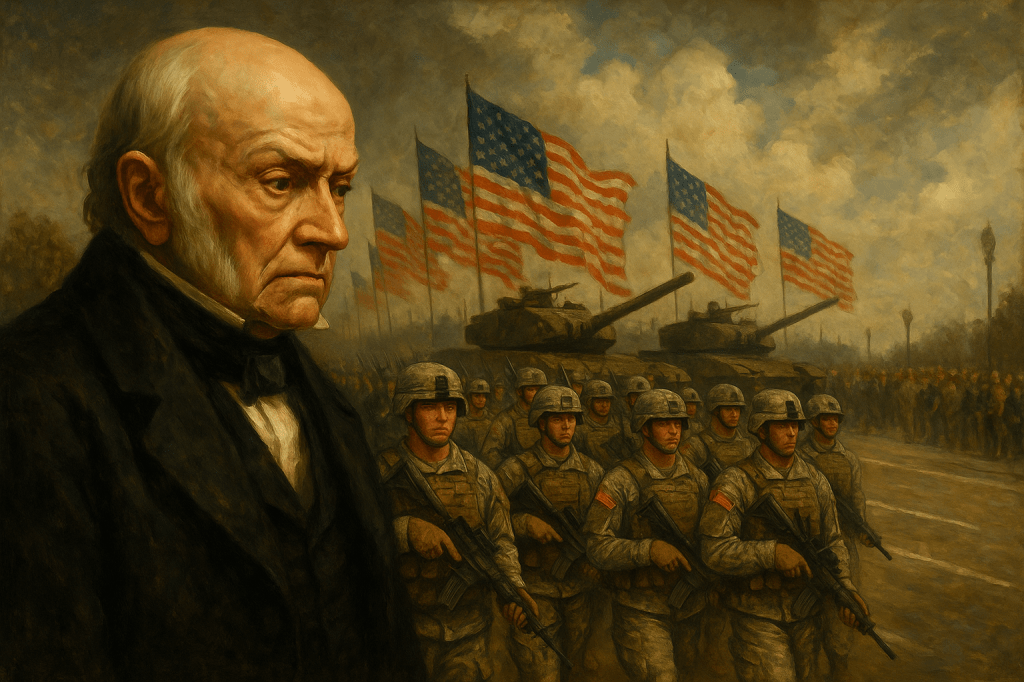
When President Donald Trump’s second term swore in on January 20, 2025, an unexpected observer from the past seemed suddenly relevant. John Quincy Adams—a patrician diplomat and the sixth U.S. president—embodies a vision of civic duty and constitutional fidelity almost antithetical to the brash populism and authoritarian displays of the Trump II era. As the world watched parades of troops on Washington streets and saw American democracy strained by executive fiat, Adams’s legacy emerged as a moral counterpoint. He is best remembered today for taking his 1825 oath on a book of laws rather than a Bible, placing the nation’s written constitution above sectarian faith. In an age when “In God We Trust” has too often become a slogan for faith-based politics, Adams’s secular republicanism and insistence on “law over personal power” feel startlingly contemporary. Across the first half of 2025, events from trade wars to crackdown on protests have underscored his wisdom: that liberty demands not pageantry, but principle; not pandering to crowds, but fidelity to conscience and the rule of law.
I. Conscience Over Popularity
In March 1825, John Quincy Adams achieved the presidency by the slender margin of the House vote, then broke custom at his inauguration. Rather than swear on a Bible, he chose a volume of legal statutes, signifying that he would answer to law and constitution above religion or personal ambition. Newspapers of the day noted how Adams had “selected the book of laws … so that he would be taking the oath … on the Constitution of the United States.” This choice was no mere gimmick: it encapsulated Adams’s belief that the fabric of American governance was secular and legal, not clerical. In his Inaugural Address he solemnly declared that in the performance of presidential duty his “first resort” would be to the Constitution he had sworn to “preserve, protect, and defend.” His private writings echoed this creed, insisting that “improvement” of society must be moral and intellectual, not purely material or demagogic.
Adams’s career—secretary of state who penned the Monroe Doctrine, polyglot ambassador, and later stubborn congressman—was marked by rigorous morality and anti-populist instinct. Born to privilege but burdened by it, he embraced an almost ascetic sense of duty. Biographers call him “aloof, stubborn, and ferociously independent.” He refused to pander, even as it doomed his presidency. Having been a widely traveled diplomat in his youth, he regarded pure popular opinion with suspicion. He once quipped that the “public has a right to be ignorant,” warning that a fickle mob can be led astray. Unlike the modern practice of political stuntmanship, Adams believed leaders should govern by principle, not by chasing media headlines. He famously advised others to “always vote for principle, though you may vote alone,” embodying conviction rather than compromise. Adams was a staunch defender of minority rights and reason: an early foe of slavery who thundered that the peculiar institution “taints the very sources of moral principles.” He championed public education, science, and infrastructure projects to “adapt the powers” of the nation for the improvement of its citizens. Above all, he honored conscience and civil virtue. To him, the strength of the republic depended on a virtuous citizenry. He believed that without high public morals a democracy will “sink into a hopeless despotism consumed by avarice and corruption.”
II. Power Without Restraint
It is this austere vision that makes Adams a foil to the Trump II administration. In just the first six months of 2025, the new president has assembled a checklist of populist-authoritarian moves that Adams would have abhorred: a flag-day military pageant, the energetic suppression of street protests, unpredictable trade wars with allies, fracturing of once-solid alliances, and the ubiquitous invocation of religion to bless the regime. Taken together, these suggest a darker direction for American democracy—one in which the secular, constitutional state yields to personality, spectacle, and sectarian fervor.
On June 14, 2025, Washington D.C. held a military parade of unprecedented scope. Armored vehicles rolled down Pennsylvania Avenue, jet fighters roared overhead, and battalions in full battle gear marched amid banners. The ostentatious event was less a celebration of the armed forces than a demonstration of centralized power. It rivaled the grandeur of authoritarian states, complete with tanks and troops arrayed in show. John Quincy Adams would have recognized it as the very antithesis of republican simplicity. His American forebears, he believed, had rejected the pomp of European courts; he himself detested excess. The 1825 parade of today’s United States, by contrast, seemed designed to awe the people into submission. Its timing on Flag Day was rich with irony: Adams took his oath on the flag of law, while Trump’s display paraded the flag of force. Where Adams regarded power with skepticism, the modern parade exalts power for its own sake.
Simultaneously, cities across the country have seen a rising tide of protest. In Los Angeles, a demonstration against an Immigration and Customs Enforcement (ICE) raid on June 6, 2025, quickly drew national attention—and a fierce crackdown. A relatively small, peaceful crowd was met by federal riot squads in combat gear. Los Angeles police declared public assembly illegal. The president then ordered National Guard troops into the city over the objections of local officials. Armored vehicles rolled into downtown to silence dissent. In the name of immigration enforcement, the administration unleashed the most forceful domestic deployment of military and paramilitary units this generation has seen.
This abrupt suppression of peaceful assembly echoed what many have called “democratic backsliding.” Commentators noted grimly that an ICE raid sparked a response befitting martial law. Tear gas and “nonlethal bullets” dispersed crowds. The governor’s pleas to stand down were ignored. Such tactics vindicated Adams’s old warning that without spirited dissent a free government ceases to be. Adams famously asked during the 1836 gag-rule fight: “Am I gagged, or am I not?” (as he stood silenced for insisting on reading an anti-slavery petition). He argued then that silencing petitioners violated the Constitution itself. Today, as cameras record Federal officers brutalizing protesters, one hears Adams’s voice reminding us that the First Amendment exists precisely so that citizens can petition and protest. In a nation where vast petitions of millions are met with violence rather than debate, the principle Adams defended—that “the right of petition belongs to all”—rings as both caution and counsel.
In the economic arena, the administration has waged war on allies under the banner of “America First.” On February 1, 2025, President Trump signed executive orders slapping 25% tariffs on nearly all imports from Canada and Mexico (and 10% on China). Overnight, the long-standing North American trade system was torn apart. Canadian prime minister Justin Trudeau protested that these tariffs were unjustified and vowed retaliation. The president openly hinted that he might use tariffs to pressure his neighbors into union with the U.S. (Indeed, Trudeau joked that annexation might be the only way to save supply chains.) Within days, Canada announced counter-tariffs on billions of American goods. Mexico prepared similar measures. Essential sectors from steel to auto parts to groceries were suddenly declared subjects of “tariff policy.” The economic shockwaves disrupted supply chains across North America.
These moves unnerved long-time allies. In Europe, anxieties grew that the U.S. now viewed trade partners as fair targets, not friends. Canada and Mexico, who had cooperated with Washington on countless issues, were suddenly cast as adversaries. In Europe, capitals braced for similar treatment. Only months earlier, during a NATO summit, President Trump had blanched at defence spending, demanded immediate billions, and even hinted at quitting the alliance. Now, reports circulated that his administration was considering undermining Ukraine’s bid for NATO membership and forcing concessions to Russia—ideas sharply repudiated by allies. Leaders in Paris and London quietly prepared new defense pacts, fearing the United States might falter. Behind closed doors, the secretary-general of NATO and European heads of state admitted they had never seen such uncertainty in the transatlantic bond. In the West’s halls of power, diplomats confessed they felt abandoned, staring at a U.S. president who labeled longtime partners as enemies and boasted of “taking revenge” on countries that didn’t bow to tariffs.
Perhaps most striking has been the surge of religious nationalism in the halls of governance. In 1825, Adams had deliberately avoided Bible-driven pageantry. By contrast, Trump’s speeches and events now drench American policy in religious symbolism. Surviving an assassination attempt (in July 2024), the president declared it “an act of God” and claimed he was “saved by God to make America great again.” On Inauguration Day and at the National Prayer Breakfast, he boasted that divine providence had chosen him. Evangelical allies openly hail him as “anointed” or even a “savior” sent to America. Holy words and hymns fill rallies. Flags emblazoned with scripture appear on Air Force One. Cabinet meetings begin with prayer. Trump’s rhetoric pulses with messianic fervor – a far cry from Adams’s sober regard for secular law.
III. When Duty Defies Power
The final piece of Adams’s legacy is his conviction that duty trumps popularity and law trumps power. He never worshipped the goddess of victory in elections. When defeated in 1828 he did not organize riots or overturn ballots. He retired quietly to scholarly life, insisting on decency in defeat. Throughout his career, he placed conscience above consensus. His famous counsel to adhere to principle even in isolation was his creed. In one quarrel over bribery in the Chickasaw treaty (an episode of U.S. expansion), he voted against his own party because he believed enforcing law was more important than obeying party discipline. He put ideas ahead of ambition, even at personal cost. In letter after letter, he bemoaned the corruptions of momentary opinion and urged Americans to be “poor and starving patriots” rather than compromising on essential values.
This rings especially true today, as the Trump administration’s every move is calculated for polls or profit. Adams’s polar opposite took office promising full-throated popularism: scorn of elites, constant cultural warfare, personal loyalty. The sixth president, by contrast, envisioned the republic as a solemn enterprise. He believed the president serves the law—he insisted, “The fundamental maxim of our Constitution…is, that a majority always requires to be restrained.” If Adams were writing an editorial in 2025, he might remind readers that the Constitution exists not to dignify every whim of the people, but to guard against majoritarian excess. His life said as much: he bitterly watched the rise of Andrew Jackson’s mob-driven politics, and he feared that unchecked popularity could make a new Caesar.
Conclusion: Reclaiming Adams’s Vision
For citizens alarmed by democratic erosion, Adams’s career offers a civic prescription. He showed that courage in opposition—rebuking one’s own party if need be—is a noble duty. He trusted education and reflection over tribalism, believing an enlightened minority should guide, even when unpopular. His model suggests that Americans today should honor institutions rather than cults of personality. Instead of succumbing to cynicism about “the rules for thee, but not for me,” they can relearn that laws apply equally. They can remember that governments are instituted among people for the people, and when government forgets this, citizens must remind it. Adams believed the highest calling of public life was the preservation of liberty through civic virtue. He urged his countrymen to “scorn the popular drum and fife,” to hold fast even against “the fury of a temptation” to sacrifice principle.
This is the heart of the editorial: just as Adams put duty above demagoguery, so should modern Americans respond. If protest is met with guns, then the people must insist, passionately yet peacefully, that rebellion against liberty is rebellion against America. If courts are packed or muzzled, then public pressure must pour forth—reminding politicians of their oaths, as Adams did at his inauguration. If leaders invoke the name of God to justify policies, citizens of all faiths (and none) must recall Adams’s vision of a common civic virtue that transcends sect. The spirit of Adams calls for a sober reflection rather than a shadow-play of power.
In closing, the once-forgotten legacy of John Quincy Adams may be the clearest beacon amid these stormy times. He believed that secular devotion to duty, morality, and law would outlast any cult of personality. A cautious, constitution-bound man, he warned that “liberty cannot long exist without virtue and independence.” To reclaim his vision is to recommit to service before self, to law before lust for power, and to the long view over the short rally. Whether Americans heed that warning will determine if their republic is truly “the rule of law, not the rule of men,” as Adams insisted. Ultimately, the question becomes: will the nation remember that, unlike Parades and Tweets and Testimonies, only an independent conscience and an unwavering commitment to the written constitution can secure its future? John Quincy Adams built no personal following, but his ideas built a nation. In June 2025, as the drums of demagoguery beat louder, his memory stands as an ironic yet urgent reminder that the America of the laws and reason still deserves defending — one citizen with principle at a time.
Bibliography
Chervinsky, Lindsay M. 2021. “Most Republican Lawmakers Have Failed John Quincy Adams — and The Constitution.” Medium.
Chinard, Gilbert. 1933. John Quincy Adams and the Foundations of American Foreign Policy. Boston: Little, Brown and Company.
Cooper, William J. 2017. The Lost Founding Father: John Quincy Adams and the Transformation of American Politics. New York: Liveright Publishing.
Hogan, Margaret A. “John Quincy Adams: Life in Brief.” Miller Center, University of Virginia.
Howe, Daniel Walker. 2007. What Hath God Wrought: The Transformation of America, 1815–1848. New York: Oxford University Press.
Kruse, Michael. 2025. “Does Trump Actually Think He’s God?” Politico Magazine, May 30, 2025.
McCullough, David. 2001. John Adams. New York: Simon & Schuster.
Mason, Jeff, Doina Chiacu, and Nathan Layne. 2025. “Tariffs on Imported Semiconductor Chips Coming Soon, Trump Says.” Reuters, April 13, 2025.
Nagel, Paul C. 1997. John Quincy Adams: A Public Life, a Private Life. Cambridge, MA: Harvard University Press.
Remini, Robert V. 2002. John Quincy Adams. New York: Times Books.
Chidi, George. 2025. “How US Cities Planned for a Trump-Led Crackdown on Protests.” The Guardian, June 14, 2025.
Kang, Susan, and Jonathan Havercroft. 2025. “Military Crackdown on LA Protests Portends Erosion of Rights.” Truthout, June 12, 2025.
U.S. National Archives. “Struggles over Slavery: The ‘Gag’ Rule.” National Archives.

 USPH
USPH 
Leave a comment