
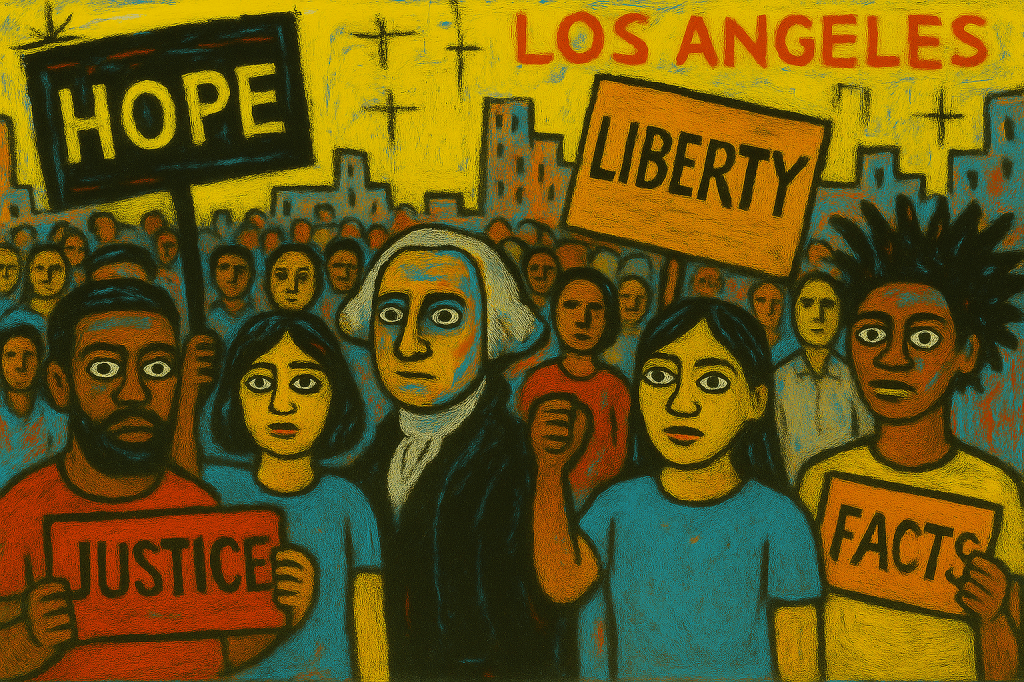
The recent protests in Los Angeles did not arise in a vacuum. They were ignited by heavy-handed federal immigration operations and have been seized upon by President Donald Trump not as incidents to defuse, but as a political opening. In a few short days, a storm of events – from paramilitary-style ICE raids to nationwide talk of “insurrection” – has underscored a dangerous trend: the normalization of military force against civilian protesters. As we unpack what happened, a clear pattern emerges. The cause of the unrest was starkly real – masked ICE agents conducting aggressive raids – yet the response has been wildly disproportionate, violating long-standing legal norms and reviving the specter of martial law. We will see that Trump’s deployment of National Guard and Marines to Los Angeles, without the governor’s consent and without formally invoking the Insurrection Act, is not aimed at quelling chaos but at creating it. By magnifying disorder and wielding the armed forces, Trump is dominating the narrative and rallying his base around a “law-and-order” campaign. In doing so, he breaks decisively with the Founders’ vision of limited executive power and civilian-controlled defense. This essay traces the origins of the protests, contrasts media portrayals, analyzes the administration’s actions and legal justifications, and situates the crisis in historical and constitutional perspective. The central thesis is that Trump craves chaos – he weaponizes it to advance himself – and that Americans must recognize the peril this poses to our republic.
I. The ICE Raids: A Flashpoint for Unrest
The immediate spark of the Los Angeles unrest was the immigration raids themselves, carried out in recent days by federal ICE officers under Trump’s edicts. In late May and early June 2025, U.S. Immigration and Customs Enforcement agents conducted simultaneous operations at several locations in Los Angeles – including warehouse workplaces and neighborhoods – detaining scores of suspected undocumented immigrants. Witnesses and journalists describe these raids as “military-style” in appearance. Federal agents in body armor and face coverings stormed sites, hauling away detained workers in dark vans. One Reuters account notes, “Images of federal immigration agents wearing masks and balaclavas as they conduct raids in Los Angeles and other U.S. cities have ignited a politically charged debate”. Local reports confirm that 118 people were arrested across the LA area during these operations, including 44 on a single Friday. The heavy-handed nature of the sweeps – agents so well-armed and hooded that residents likened them to “paramilitary units” – enraged community members. Thousands of longtime Los Angeles residents, many fearful and angry, streamed into the streets in response.
Activists organized immediate demonstrations at the scenes of the raids. Crowds gathered outside buildings where detained immigrants were believed to be held. As one Independent report describes it, “Crowds tried to stop ICE agents from driving away following the arrests”. When bystanders learned that immigrants were being taken to the downtown federal detention center, they gathered on its steps chanting, “Set them free! Let them stay!”. Additional protests erupted in South LA suburbs like Paramount and Compton when new raids began there. According to the Los Angeles County Sheriff, roughly 400 people joined one such demonstration in Compton. Far from being isolated incidents, the raids spread rapidly through the region, inflaming tensions in a city with a large immigrant community. Many protesters emphasized that their anger was squarely directed at the policy behind the raids. As one marcher told NPR, “We have to stand united against the attacks on the immigrant community, because an attack on one of us is an attack on all of us”.
These protests were fueled by very real grievances about the ICE tactics. The raids were not simply routine enforcement actions; they were part of a recent uptick in anti-immigrant crackdowns ordered by the White House. Officials from President Trump’s administration have openly emphasized a hard line on immigration, and many in Los Angeles saw the coordinated, masked raids as an intimidation campaign against vulnerable communities. As one former ICE official put it, the appearance of heavily armed, name-hidden agents “goes against typical American law enforcement practices” and seemed intended more to “frighten immigrants” than to simply uphold the law. With this raw anger as a backdrop, large crowds began to fill the streets.
In fact, one Reuters photo shows how local neighborhoods were drawn into the controversy. Neighbors brought chairs and signs to the federal building, turning its steps into an impromptu street forum. Young families and longtime residents pressed for information: they demanded to see loved ones or just to know what would happen to those seized. This image of ordinary Angelenos standing up to federal agents underscores the community-oriented nature of the outrage. It was far from a foreign “insurrection” – it was a local protest against federal policy. Yet this grassroots response would soon be dwarfed in the media by spectacular images of smoke and violence.
II. The Protests Erupt
By the weekend following the raids, Los Angeles had entered a multi-day cycle of protest and confrontation. Thousands of citizens, young and old, took to the streets in neighborhoods across the city. On Saturday and Sunday, peaceful marches and vigils were common, but clashes also broke out in multiple locations as crowds grew larger. As the protests unfolded, law enforcement everywhere increasingly resorted to aggressive crowd-control measures. Police lines in riot gear moved in with tear gas canisters, rubber bullets, and stun grenades. The Associated Press reports that “tensions in Los Angeles escalated Sunday as thousands of protesters took to the streets… blocking off a major freeway and setting autonomous vehicles on fire” while officers used “tear gas, rubber bullets, and flash bangs” to disperse them. On the city’s 101 Freeway, for example, demonstrators formed barricades and ignited cars. Officers, backed by California Highway Patrol units, declared the gatherings unlawful as dusk fell. Some protesters threw bottles, rocks and fireworks at officers. LAPD and CHP confirmed that a handful of cars were burned on Interstate 101 and at least two officers suffered injuries (none life-threatening) from thrown debris, as captured on police body-cams. By the fourth day of protests, law enforcement said they had arrested 53 people on charges ranging from failure to disperse to assault and arson.
Despite these flashpoints, careful reporting shows that the vast majority of demonstrations remained nonviolent expressions of anger. Many participants insisted on peaceful protest. “Everyone here wants to be peaceful,” one marcher told NPR. In South Los Angeles neighborhoods like Watts and Paramount, residents formed human chains and held signs calling for compassion. Activists chanted slogans such as “Set them free!” and “This is our city!” – a grassroots energy captured in local media but often overlooked by national coverage. Thousands of silent vigils and family walks took place on sidewalks in L.A. and satellite cities, according to organizers.
At the same time, scattered incidents did occur. On Sunday evening in downtown L.A., police wearing body armor shoved past bystanders to break up a skirmish on the freeway. Many demonstrators then moved into side streets and alleys. A CBS News crew reported that at one point protesters constructed makeshift barricades across a roadway; some behind the barrier lobbed chunks of concrete, rubble, and personal items – electric scooters, water bottles and even rocks – at officers in vehicles. In one widely-circulated image, a protester can be seen launching a firework from behind a dumpster at police in riot gear (see below). Such moments produced clouds of CS gas drifting over freeways, and strobe flashes from stun grenades. But they were episodes – not the entirety – of the demonstrations. As a Sheriff’s deputy told reporters, most of the arrested protesters were charged not with terrorism or insurrection, but relatively minor offenses like throwing fireworks or graffiti.
One photo, from The Independent, shows one such confrontation. Here, an officer in tactical gear deploys crowd control while a demonstrator launches a small firework down the freeway. To some viewers, this picture screamed “insurrection”; to many protesters, it was a portrayal of frustration after days of injustice. In the aftermath, law enforcement pointed out how isolated these clashes were. By midday Monday, the combined total of arrests across LAPD, CHP, and county agencies was only 53 – a small fraction of the total turnout. California Highway Patrol spokesman Diana Coronado noted that those detained had committed specific crimes (illegal occupation of the freeway, arson of vehicles, throwing objects), distinguishing them from the peaceful majority. In short, the events featured both genuine civil unrest and a strong current of lawful protest. The human reality in Los Angeles was complex: families worried for detained relatives, activists supporting immigrant rights, neighbors protecting their streets – all of whom had been drawn into an outpouring of civic engagement.
Meanwhile, the media began to diverge sharply in their portrayal of these events. Some outlets focused on property damage and arrests, framing the story as one of lawlessness. Others emphasized the peacefulness of the marchers and the context of the raids. Veteran journalists noted the difference: where NPR reported, “Demonstrators said the protests had been mostly peaceful… ‘We’ve been standing here for quite a while, and no one is menacing the National Guard. Everybody is just standing up for their own freedom,’” conservative media largely highlighted fiery clashes. This split became a defining feature of the narrative war.
III. Media Narratives: “Riot” vs. Resistance
Within hours of the first clashes, a communications war erupted over what to call these events. President Trump and his allies in conservative media immediately labeled the gatherings as “riots” that threatened civic order. In the White House and on right-wing networks, the protests were portrayed not as a grassroots outcry against policy, but as mobs of criminals needing suppression. The New York Times and NPR noted that “President Trump and conservative media have labeled the protests in Los Angeles as a ‘riot’ and said that justified deploying the National Guard”. Indeed, Trump himself proclaimed repeatedly that “it was a riot” and that only a federal intervention could restore “law and order”. Late on Sunday, he tweeted a mocking taunt at Governor Gavin Newsom – calling him “Gavin Newscum” – and demanded, “Bring in the troops!”. This messaging was echoed by Fox News hosts who ran rolling “Live Updates” framed as “anti-ICE riots” and quoted Republican law enforcement officials promising “zero tolerance” for any defiance.
Fox News coverage, for example, highlighted crime over context. A Riverside County sheriff, Chad Bianco (a GOP gubernatorial hopeful), was quoted accusing Democrats of “gaslighting” the public into thinking these were “peaceful protests” and insisting that anyone blocking freeways or vandalizing cars would face arrest. On air, he condemned the mayor of L.A. and Speaker Pelosi for supposedly downplaying violence. The segment underscored every fiery image: a shot of a burned police car, video of graffiti on buildings. Most eye-catching was Fox’s emphasis on the new military posture: its reporters announced that 500 Marines had been put on “prepared to deploy” status in Southern California. In one bulletin they repeated the Pentagon’s statement word-for-word: “Approximately 500 Marines… are in a prepared to deploy status should they be necessary to augment and support… protection of federal property and personnel efforts,” adding that “approximately 2,000 California Army National Guard soldiers have been placed under federal command”. On this network, scenes of confrontation were used to stir public fear: terms like “rioters,” “looters,” and even “insurrection” began peppering the commentary. One Fox affiliate even hinted that invoking the Insurrection Act might be on the table.
Outside the conservative echo chamber, other media told a different story. National newspapers and networks largely gave voice to protest organizers and analysts who emphasized immigration issues, sanctuary laws, and civil rights. The Independent and the Associated Press focused on the causes – the ICE raids and the immigrant families affected. AP’s coverage on Sunday noted that “thousands” blocked a freeway and burned cars, but carefully mentioned it happened amid a “showdown” over immigration policy. NPR’s on-the-ground reporting highlighted protesters’ peaceful intentions and the heavy police response. Even on cable TV, CNN and MSNBC featured city officials and civil liberties experts condemning the militarized raids and defending the right to protest. A key point repeated across these outlets was that local police in L.A. had actually been restrictive about immigration enforcement (due to the state’s sanctuary laws), so the disturbances were uniquely a response to federal action.
In short, two narratives emerged: one, pushed by Trump and aligned outlets, saw a city at war with anarchists and illegal immigrants, demanding a hard crackdown; the other, voiced by independent journalism, saw concerned communities reacting to authoritarian tactics and calling for justice. The social media echo chamber further amplified this split. On platforms like Twitter and Parler, many MAGA accounts treated every looted store or police push as proof of a hidden BLM-style conspiracy in the Biden administration. By contrast, citizen videos shared on Facebook and TikTok tended to show long lines of families waiting to get into protests, or peaceful marches with children.
President Trump leaned fully into the “riot” narrative. In remarks from the White House, he derided critics who blamed his policies for the unrest, instead blaming California’s leaders: “If Governor Gavin Newscum and Mayor Karen Bass can’t do their jobs, … then the Federal Government will step in and solve the problem, RIOTS & LOOTERS,” he tweeted. In public statements, Trump justified his troop deployments by insisting that the protests had become “very bad” riots that required federal action. He even warned (on record at the time) that he could send troops to other cities if similar protests occurred, vowing “to have troops everywhere” to protect order. All of this was clearly aimed at shoring up his core message: that the country was on the edge of chaos, and only he could restore stability.
In effect, pro-Trump media were echoing his campaign-style rhetoric rather than reflecting the nuance on the ground. This includes fringe voices as well; some commentators began drawing parallels between these protests and the January 6 Capitol riot – an analogy entirely absent from mainstream reportage. Even convicted Jan. 6 insurrectionists on social media quipped that the Los Angeles scenes were “larger in scale” than last winter’s siege (ignoring the crucial fact that the 2025 demonstrations were about enforcing immigration law, not overturning an election). No credible new evidence of sedition emerged. Yet the specter of insurrection was deliberately invoked. In effect, the chaotic imagery was pumped back into the news cycle to terrorize moderates and energize the right-wing base. At moments, the narrative seemed inverted: peaceful calls for due process were branded illegal, while any crackdowns were hailed as heroic.
IV. A Presidential Power Play
Rather than de-escalating, the Trump administration escalated. On Saturday, in a move unprecedented in recent history, the White House announced it would federalize the California National Guard and deploy 2,000 troops to Los Angeles. This came without Governor Newsom’s request or consent, marking a sharp break from the usual process. Within hours, orders were faxed to Guard units, and by Sunday armed soldiers were seen staging at key points around the city. Defense Secretary Pete Hegseth explained that the Guard would be used to “protect federal personnel” – specifically to guard ICE officers and federal buildings, including the downtown immigration jail. But the justification went further. In a public memo posted by the Pentagon, commanders were told to treat not only current protest sites but also potential ones: troops could be sent preemptively to “locations where protest against [federal] functions are occurring, or are likely to occur”. In short, the military was put on notice that any planned protest might be met by federal force.
The administration also put hundreds of Marines on standby. On Sunday, Hegseth announced that 500 Marines from a base in Twentynine Palms, California, were on “prepared to deploy” status for homeland duties. NBC and CNN reported separately that active-duty Marines were being placed on high alert at Camp Pendleton. Though no active-duty troops actually appeared on LA streets during the first days, the announcement itself was freighted with symbolism. It signaled that the President considered domestic protests worth using the fightin’ Marine Corps for – a move that even congressional watchdogs found extraordinary.
Governor Newsom was furious. He immediately sued the federal government, calling Trump’s unilateral federalization of the Guard “illegal and immoral”. In an interview, the Governor warned that sending soldiers without coordination would only inflame passions, not calm them. Local officials echoed this: Los Angeles Mayor Karen Bass labeled the ICE tactics “terror” and said, “We will not stand for this.” Even some prominent conservatives expressed misgivings. A Fox News report noted Riverside County Sheriff Chad Bianco, normally a Trump ally, chastising the president: “President Trump didn’t start these riots. He’s not out there lighting cars on fire… This statement [by Democrats] is an embarrassment,” implying that the unrest was being politicized.
All the while, Trump publicly reveled in the turmoil. His rhetoric made clear that this deployment was not merely a response to violence, but a political spectacle. He traveled to Camp David to rally his supporters, castigated critics for not supporting him on “law and order,” and repeatedly suggested that former President Biden was too weak (“using an autopen” to sign letters) while he would crush disorder. In press briefings he noted that in his first term he had been “too nice” to George Floyd protesters and that this time he would be “very, very strong”. Officials around him echoed this posture: former Acting DHS Secretary Pete Homan explicitly admitted that ICE officers had been “doxxed,” thereby portraying opposition to them as inherently criminal.
Through these actions, Trump transformed the protests into a political event choreographed by the White House. Each flare and bottle became a punchline in Trump’s constant tweets. (He even tweeted out a video of burning cars with the caption, “Bring in the troops!”). By amplifying the chaotic moments – real or staged – Trump sought to justify ever-harsher measures. The cycle was clear: first provoke outrage (by dramatic ICE operations), then confront the ensuing anger with military force, then declare victory over “riots,” all while claiming that only he can restore stability. This pattern was no accident. Long before these protests, Trump’s advisers had discussed invoking the Insurrection Act to quell anticipated dissent, and he had flirted with deploying troops against American cities during the 2024 campaign. Many analysts note that in his second term Trump is doing “things he thought about but stopped short of doing in his first term”. Sending troops to L.A. and publicly branding immigrants as enemies fits that mold.
Crucially, Trump did all this without using the normal legal mechanisms for domestic deployments. He never declared an insurrection under the Insurrection Act – the 1807 statute that, for nearly two centuries, has been the exclusive legal channel for federal intervention in state affairs. Instead, the White House cited a general provision of Title 10 of the U.S. Code. The executive order invoked the President’s power to call forth troops “to repel invasion and suppress rebellion” (10 U.S.C. § 331) and to ensure enforcement of federal law. In plain terms, the administration claimed that the unrest “met the definition of a rebellion” and thus authorized using the military. This approach bypassed the Posse Comitatus Act (PCA), the 1878 law that bars federal troops from domestic policing except by explicit statutory exception. In effect, Trump is skirting PCA by treating the protests as a rebellion under Title 10, rather than formally invoking the Insurrection Act.
This is uncharted territory. A Washington Post analysis noted that every prior president who mobilized forces for civil disturbances did so under both Title 10 and the Insurrection Act. For example, President Bush in 1992 quashed the LA riots after a governor’s request; he used the Insurrection Act in tandem with Title 10 authorities. By contrast, Trump’s Title 10 invocation alone is an “untested departure” from past practice. Several legal experts expect immediate court challenges to this move. In fact, a bipartisan coalition of 22 Democratic governors announced that the federal activation “without consulting or working with a state’s governor is ineffective and dangerous”. Even some constitutional conservatives have pointed out that the statute Trump cited (10 U.S.C. § 12406) only permits federalization through the governor, not by ignoring him. Josh Gerstein, a legal reporter, explains this ambiguity: the law’s text requires an order to be “issued through” the governor, but it doesn’t clearly say the governor can veto or even be notified. Thus the courts may have to interpret whether Trump abused his authority.
In practical terms, the civilian leadership of California has been sidelined. Under normal protocol, a governor might place the Guard under Title 32 status, keeping them under state control even if federally funded. But the Trump administration has clearly declared these Guard troops “federalized” – i.e. under Title 10 – cutting Governor Newsom entirely out of the chain of command. Title 10 status means those soldiers are now bound by federal orders, not by California law. In other words, orders in Los Angeles now flow from the Pentagon, not the Governor’s office. (For comparison, remember how in 2020 the Trump administration asked other governors to send their National Guard units into DC under Title 32 “to support” federal police; even then, that was criticized as a workaround of the law. Here, Trump skips even that gesture.)
In sum, the White House’s actions are a pre-emptive militarization of a domestic protest movement. The Guardian reports that the deployment order explicitly covers anticipated protests – a step so unprecedented it “has never been seen before in the US”. It even authorizes troops to shield ICE agents during future raids on businesses and homes. This sweeping authority turns ordinary street protests into potential military actions by presidential fiat. That should alarm every student of American democracy.
V. Constitutional and Legal Issues
From a constitutional standpoint, the administration’s moves raise deep questions. The U.S. Constitution names the President as “Commander in Chief,” but that role was meant to be checked by Congress, state governments, and the courts. The Founders – and later legislators – deliberately feared mixing military power with civil order. The Posse Comitatus Act of 1878 codified this wariness: it “bars federal troops from participating in civilian law enforcement except when expressly authorized by law”. In practice, this means that unless Congress has carved out an exception, the Army and Marines cannot patrol American streets or enforce civilian crimes.
The Insurrection Act provides those limited exceptions. As the Brennan Center explains, “The most important [exception] is the Insurrection Act. Under this law, in response to a state government’s request, the president may deploy the military to suppress an insurrection in that state. In addition, the Insurrection Act allows the president – with or without the state government’s consent – to use the military to enforce federal law or suppress a rebellion against federal authority in a state”. Notice the emphasis: the standard Insurrection Act option requires either a state governor’s request or a rebellion so dire that the President must act.
Trump has not met either condition. Los Angeles has not been formally overrun; nor has Governor Newsom asked for this aid. Instead, the President essentially declared rebellion by fiat, equating the ongoing ICE protests with an insurrection. But legal scholars point out that courts have traditionally given the President wide leeway in deciding what constitutes an “insurrection” or “rebellion” – meaning they often defer to his judgment in such matters. That is why Josh Gerstein correctly observed that Newsom’s lawsuit faces an uphill climb: “the law Trump invoked requires him to consult with or get the permission of the governor” is a “debatable interpretation”, and whether the situation qualifies as a rebellion “seems pretty subjective”. In short, the executive branch is likely to argue that it is simply exercising powers Congress gave it to secure federal law and personnel.
Yet this de facto federalization raises constitutional issues. The Tenth Amendment reserves to the states powers not delegated to the federal government. Police power over civil matters – typically including immigration enforcement on a local level – is one such state power (subject only to federal supremacy in immigration law itself). Here, Los Angeles authorities have almost wholly refused to assist ICE due to California’s sanctuary policies; they consider the issue local in nature. By marching in National Guard and Marines, the President is overriding the state’s chosen approach. This directly brushes up against federalism principles.
Even if the courts ultimately side with Trump on the statute, the political fallout is ominous. The Washington Post reported that California’s governor formally demanded the deployment be rescinded because “the administration had not followed proper legal procedure”. Other governors expressed solidarity: one joint statement signed by 22 governors (including Republicans) warned that federalizing state troops without consent “is ineffective and dangerous”. These reactions highlight how extraordinary the move is. At bottom, it tests the unwritten norm that civilian leaders and local authorities should manage civil order. By invoking military power for a homeland protest, Trump is bumping up against the constitutional principle of civilian control – one that is more than a formality.
In more concrete terms, the maneuver also touches on Posse Comitatus. By placing Guard troops under federal control (Title 10 status), the administration has largely made them subject to PCA rules. Ordinarily, this would forbid them from performing arrests and searches. However, by framing the mission as protecting federal functions, the White House attempts to carve out an exception. And we note that in recent years, loopholes in PCA have been exploited by previous administrations. For example, in 2020 the Trump White House federally commandeered the DC National Guard (under Title 10, ironically) and even arranged for friendly governors to send Title 32 Guard troops into DC, all to bolster force without passing an Insurrection Act declaration. It is precisely this playbook that current officials appear to be drawing from – though in L.A. they skipped the pretense of mutual cooperation.
What legal scholars caution is that none of these maneuvers has been thoroughly tested in court. If Trump can use Title 10 alone to override a state governor, what stops a future president of any party from doing the same? The Wall Street Journal editorially called Trump’s deployment “unnecessary, inflammatory, and an abuse of power”, pointing out that half the city’s voters cast ballots for Trump’s Democratic rival. At stake here is the fundamental division of war and peace powers in American law. Our Framers assumed that martial force within the country would remain a last resort, not a routine tool of policy. Ignoring those boundaries threatens a slide toward executive aggrandizement.
VI. Historical Context: Parallels and Precedents
The friction between federal authority and local protest is not new in American history, but the Los Angeles case is unique in its details. The closest comparison is the 1992 Los Angeles riots, after the acquittal of officers who beat Rodney King. President George H.W. Bush then ordered 4,000 National Guard troops into the city – but crucially, at the request of California’s governor and Los Angeles’s mayor. The 1992 riots were a true emergency: over 60 people died, and large parts of the city burned. By any measure, Bush’s intervention was aimed at restoring order in a breakdown that local authorities themselves begged to quell. As one commentator noted, Bush acted with every guarantee of legitimacy: “The National Guard’s deployment came at the request of California’s then-Gov. Pete Wilson and Mayor Tom Bradley”.
By contrast, this spring’s protests – while significant – have produced far less destruction. As Time magazine bluntly observed, “Compared to the destruction and violence in 1992, the damage resulting from the demonstrations thus far against ICE has been minor”. There have been no multi-day riots of the magnitude of April 1992; there were no hundreds of injuries, no citywide conflagrations. Nevertheless, President Trump dispatched a similar number of troops – 2,000 – into Los Angeles. And remarkably, he did so against the wishes of the state’s governor. Time again: “President Donald Trump deployed the National Guard to Los Angeles against the wishes of California Gov. Gavin Newsom, marking the first time a President has done so without the governor’s consent in six decades”. Indeed, historical record-keeping shows that the last time a federal president sent troops into a state over that state’s objections was President Lyndon Johnson in 1965. LBJ sent federalized Alabama National Guard units and U.S. Army troops into Selma to protect civil-rights marchers, over Governor George Wallace’s resistance.
This historical contrast is telling. In the 1960s, intervention on behalf of civil rights was widely seen (in hindsight) as the federal government enforcing the Constitution’s guarantee of equal protection. A future president used his authority to defend lawful protesters against violent state resistance. Today’s use of force is essentially the mirror image: the federal government is deploying troops to restrain lawful public protest and assist federal law enforcement in carrying out raids. As retired Gen. Paul Eaton (a former commander of U.S. forces in sub-Saharan Africa) warned military audiences, “The last time [a President federalized the Guard against a governor’s will] was in 1965, when Lyndon Johnson deployed them to protect civil rights marchers in Alabama”. He concluded: “This is the politicisation of the armed forces,” likening today’s soldiers on the streets of California to “that man on horseback… out in front of American citizens”.
Another parallel is instructive. In early 2020, during the George Floyd protests, Trump repeatedly threatened to invoke the Insurrection Act and send the military into cities like New York and Portland. But he was checked by his own Defense Secretary and others, and the Army remained in barracks (the Insurrection Act was not used). This time, with a compliant entourage, Trump has quietly sidestepped that process altogether. The washington Post notes that although Trump told reporters he hadn’t invoked the Insurrection Act, he did use Title 10’s “danger of rebellion” clause to justify the deployment. In fact, Section 12406 of Title 10 explicitly authorizes the President to call up the Guard to “protect federal employees” – which his order cited. This is a more limited and mechanical grounding, not the sweeping emergency authority of the Insurrection Act. As one Los Angeles Times columnist observes, Trump’s move “does not seem unlawful on its face” because it technically invokes that Title 10 provision. However, the columnist argues, it still violates deeper norms by skipping the Insurrection Act’s safeguards. In particular, the columnist notes: “Every time a protester burns a car… the protester ceases to be a lawful demonstrator and becomes a rioter.” That observation – that any act of violence on either side would instantly become political ammunition – underscored his conclusion: “The political utility of domestic unrest is far more acute under Donald Trump.”
A final historical note: the federalization of local law enforcement powers hearkens back to the founders’ era. The Framers deliberately created a professional army but envisioned it for national defense and occasional emergencies abroad. They were deeply suspicious of using the military at home. The citizen-militia (later the National Guard) was meant to be the bulwark against foreign invasion, not the regime’s instrument for quelling unpopular protest. George Washington himself proclaimed that under the Constitution, “When we assumed the soldier, we did not lay aside the citizen.” Every Founding Father echoed a similar sentiment: as Thomas Jefferson put it, “Every citizen should be a soldier.” This belief that the army should be subordinate to civil society is at the heart of our tradition. Yet the spectacle in Los Angeles turns that idea on its head: Americans are now seeing active-duty soldiers and federal troops deployed in what is essentially a domestic political conflict.
VI. Founders’ Vision and Civilian Control
The deployment of armed forces against civilian protesters runs counter to centuries of American political theory. The Constitution, after all, divides power among the branches and between federal and state governments in part to prevent just this kind of overreach. The notion that the Chief Executive might unilaterally decide “rebellion” and send troops into a major city with a Democrat in charge would have alarmed the Framers. Indeed, the historical record is replete with warnings. The Federalist Papers – Hamilton and Madison’s commentary on the new government – stressed that the people and their elected legislatures, not a standing army, are the ultimate guarantors of liberty. A key principle was civilian oversight: all military force must answer to the authority of the states or Congress, not operate on its own.
We have already seen echoes of this in the reactions of California’s civilian leadership. Governor Newsom and Mayor Bass both deplored the military turn, emphasizing that civic problems should be solved by police and the courts, not soldiers. The very fact that Newsom has pursued legal action and convened governors in opposition speaks to the foundational idea of federalism. The California Constitution (like many states) explicitly vests control of the National Guard in the Governor. In a representative democracy, it was assumed that if civil disorder arises, it is primarily a matter for local authorities – with the feds stepping in only in extraordinary circumstances.
The radical change today is not merely one president’s impulse, but a shift in norms. Veteran military officers have publicly warned that this pattern threatens to politicize the armed services. They recall that U.S. troops have rarely been used to suppress political dissent; doing so undercuts the idea that soldiers serve the nation, not a particular party. As one former general put it, seeing troops on city streets amid partisan conflict is like “casting the military in a terrible light – it’s that man on horseback, who really doesn’t want to be there, out in front of American citizens”. In other words, soldiers and sailors are uncomfortable in this role. Most Americans believe their armed forces should be guarding the country’s borders and seas, not taking orders to advance domestic policy.
Compare this with the Founders’ own language. When drafting the Constitution, they deliberately limited the President’s powers over domestic military action. They trusted in the citizen-militia precisely because they feared a standing army’s meddling in everyday life. Even the Constitution’s drafters wrote the Insurrection Act to require either a state’s own plea or a true rebellion before unleashing the army. The 20th century Democrats and Republicans who later affirmed civilian control would have recoiled at a Commander-in-Chief insisting on deploying troops to American streets as his first choice.
We must remember these principles now. Our Republic rests on the idea that the military is subordinate to elected officials and subject to the rule of law. Once the military is seen as a partisan instrument – standing behind one party’s narrative – the whole structure is endangered. The events in Los Angeles are a sober reminder of why the founders enshrined so many checks: “the government of the United States,” one Framers’ aide wrote, “cannot settle into despotism unless the people themselves choose to abjure their genius of self-government.” Normalizing soldiers in places of protest is a step toward that despotism.
VII. The Danger to Democratic Norms
The Los Angeles deployment signals a broader and graver danger to our democratic republic. If a president can send troops to intimidate a domestic protest movement, what precedents are we setting? Every democracy on Earth – and many authoritarian states – use the military to protect the regime from internal dissent. The very resort to war-trained troops against ordinary citizens breaks the unwritten boundary between warfighting and law enforcement. Today’s operation appears to tear down that boundary.
One immediate risk is that nonviolent protest will become too frightening for most citizens to practice. In immigrant communities especially, families may now fear attending any public assembly or workplace where ICE agents could be lurking behind a Marine. This “chilling effect” was predicted by Los Angeles lawmakers: more people might stay home or refrain from civic activities, worrying they could be profiled or wrongfully detained as a result of sweeping immigrant-roundup policies. That is a devastating outcome for a pluralistic society. In an open democracy, people must be free to voice dissent and hold government accountable without fearing martial law.
There is also a legal-cultural cost. Each bypass of normal procedure chips away at the presumptions that have long limited executive power. Indeed, commentators note that once one president flouts a check, the next will feel entitled to follow suit on the other side of the aisle. President Biden or another future Democrat could cite Trump’s example to justify sending federal troops against a Tea Party or conservative march. This is the slippery slope: norms become excuses. The Los Angeles case thus raises a bigger question: do we trust the next administration – whichever party – to obey the same boundary?
International observers have noticed. Our use of active-duty troops for this purpose risks damaging America’s image as a stable democracy. Our Constitution inspired nations worldwide precisely because it constrained the military. We now risk joining the ranks of governments that squash dissent with armored columns. For the troops themselves, this is demoralizing. As one retired U.S. general observed, “it casts the military in a terrible light”. They are trained to defend the nation from external threats and, to a very limited degree, assist in domestic crises like natural disasters. They are not trained as riot police. Pushing them into an urban political context threatens their morale and the long-term professionalism of the force.
Finally, there is an enduring moral principle at stake: our republic was founded on the idea that force should serve the people’s will, not suppress it. A constitution that begins “We the People” does not presume the people need martial coercion to follow the law. If citizens in their own living rooms or on a peaceful street find themselves confronted by soldiers with rifles, we lose something vital. Every historian knows that turning an army inward is how republics fall. Rome’s fall, for instance, accelerated when generals started using troops against Roman citizens. We should be sober enough to see a similar dynamic playing out here on the fringes.
Conclusion: Vigilance and Civic Resistance
The Los Angeles protests and the federal response are a clarion call. They test the boundaries of law, authority, and liberty in one of the world’s oldest continuous democracies. Yet the imperative is clear: facts, legal principles, and historical awareness must remain our compass—not fear or tribal reflexes. This is not a moment for spectacle or polarization, but for dispassionate vigilance. We have seen what triggers this dangerous escalation: a president who stands to gain politically from unrest. History—American and global—reminds us that unchecked militarization of civilian life is a well-worn path to tyranny.
The burden now lies with those entrusted with public power—lawmakers, judges, journalists, and engaged citizens—to demand transparency and accountability. No leader should be permitted to rewrite the rules of engagement to serve their own ambition. Clear questions must be asked: Under what legal authority did the President override the governor’s control? How are civilian detainees being treated? And are the safeguards of constitutional democracy still being honored?
In the American tradition, vigilance has long been the price of freedom. Today, that vigilance must take the form of civic engagement: attending local meetings, defending civil liberties, supporting the rule of law, and staying informed through trustworthy sources. What’s unfolding in Los Angeles is more than a crisis—it is a stress test for democratic institutions.
From the outside, I write as a historian and observer committed to those principles that define democratic life: civilian oversight of the military, due process over force, and the right to dissent as a vital part of public life. The marchers in Los Angeles began with a clear, local grievance. They deserve to be heard under the law, not drowned out by the drumbeat of federal deployments. If Americans—and those who care about the fate of democracy more broadly—remain grounded in legal clarity, historical memory, and moral seriousness, the slide toward authoritarianism can still be resisted. This is how republics endure. And this is how freedom is preserved, not just for one country, but for the democratic idea itself.
Sources:
Associated Press. “ICE Raids Spark Protests, Road Blockades and Fires in Los Angeles.” Associated Press, June 8, 2025. https://apnews.com/article/los-angeles-protests-ice-immigration.
Brennan Center for Justice. “The Posse Comitatus Act Explained.” Brennan Center, updated 2024. https://www.brennancenter.org/our-work/research-reports/posse-comitatus-act-explained.
Cheung, Philip. “Sheriff’s Deputies Respond to Protesters in Los Angeles.” The New York Times, June 9, 2025. https://www.nytimes.com.
Gerstein, Josh. “Trump’s Legal Justifications for Troop Deployments Face Scrutiny.” Politico, June 9, 2025. https://www.politico.com.
Guardian Staff. “Trump Orders Troops to Anticipate Protests across U.S.” The Guardian, June 9, 2025. https://www.theguardian.com/us-news/2025/jun/09/trump-military-deployment-protests.
Independent Staff. “Los Angeles Erupts after Masked ICE Raids.” The Independent, June 8, 2025. https://www.independent.co.uk.
Los Angeles Times Editorial Board. “Trump’s Dangerous Use of Federal Troops in Los Angeles.” Los Angeles Times, June 9, 2025. https://www.latimes.com.
NPR Staff. “Immigration Protests Spread beyond LA, Prompting National Reaction.” NPR, June 9, 2025. https://www.npr.org.
Reuters Staff. “Masked ICE Raids Spark Anger and Protest in California.” Reuters, June 8, 2025. https://www.reuters.com.
Sanger, David E., Helene Cooper, Eric Schmitt, and Laurel Rosenhall. “Trump Administration More Than Doubles Federal Deployments to Los Angeles.” The New York Times, June 9, 2025. https://www.nytimes.com.
Savage, Charlie. “The Legal Issues Surrounding Trump’s Use of Troops to Suppress Protests.” The New York Times, June 8, 2025. https://www.nytimes.com.
Time Staff. “How the 2025 Protests Compare to the 1992 Los Angeles Riots.” Time, June 9, 2025. https://time.com.
Washington Post Staff. “Trump’s Military Deployment Tests Limits of Domestic Use of Force.” The Washington Post, June 9, 2025. https://www.washingtonpost.com.

 USPH
USPH 
Leave a comment