
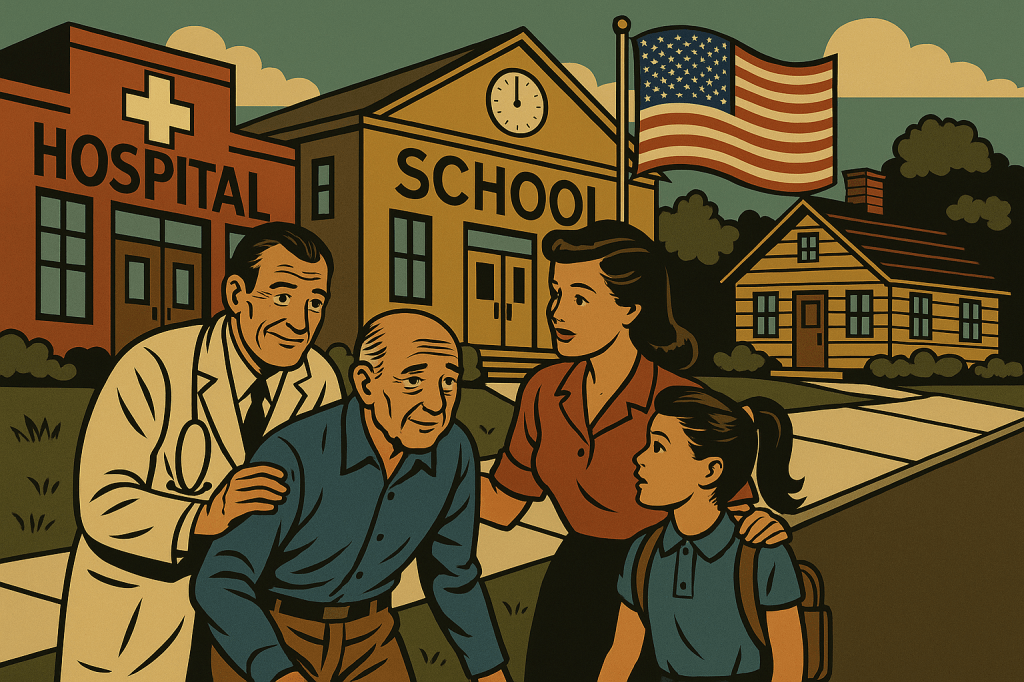
The idea of a “welfare state” – a government that ensures the economic and social well-being of its citizens – has been most closely associated with Northern Europe. In the United States, traditions of individualism and limited government long clashed with this model. Yet crises and politics compelled many American leaders to build a federal safety net. Beginning with the New Deal in the 1930s, the American welfare state grew through piecemeal legislation, reflecting U.S. values and divisions. This essay traces the historical arc of that development – from Social Security to Medicare and Medicaid, through later reforms – and explores how social programs reshaped American democracy and citizenship. In particular, it considers how welfare policy has influenced notions of equality, rights, and public trust, and compares the U.S. model with those of Belgium and Sweden. We conclude with grounded reflections on the future of social policy in America and its role in a healthy democracy.
Origins and the New Deal
Before the 1930s, public assistance in America was limited. In the 17th–19th centuries, states relied mainly on “poor laws” and local charity to aid the destitute. Families, churches, and private relief organizations carried most of the burden. Progressive reformers of the late 19th and early 20th centuries began to advocate more government action, but major social programs were still mostly unknown. The prevailing political philosophy remained Jeffersonian: as one historian notes, Americans “of all classes have characteristically looked upon government action as a ‘last resort’”. Alexander Hamilton’s vision of an “activist” state existed alongside, but the Jeffersonian ethos held sway in social welfare.
The turning point came during the Great Depression. In the New Deal of the 1930s, Franklin D. Roosevelt’s administration created America’s first large-scale welfare programs. The cornerstone was the Social Security Act of 1935. This law established old-age pensions and unemployment insurance, funded by payroll taxes. In Roosevelt’s words, it created a federal “safety net” for the elderly, the unemployed, and the disadvantaged. Under Social Security, most workers would receive a retirement benefit at age 65, based on contributions they had paid. The Act also formalized unemployment insurance at the federal-state level. By 1940, the Social Security program was fully in place, although at very low benefit levels.
Other New Deal initiatives included Aid to Dependent Children (later Aid to Families with Dependent Children, AFDC), a federal version of “mothers’ pensions” for widows, and Old-Age Assistance for the very poor elderly. These were the first time the federal government provided cash relief to families and the needy, although benefits were minimal. Labor unions and social activists also pushed for programs like public works and minimum-wage laws, but Social Security and unemployment insurance were the major lasting legacies of this era.
Despite its groundbreaking scope, the New Deal welfare state had sharp limits. Initially Social Security excluded many workers: “domestic and agricultural workers” (disproportionately African-Americans and women) were not covered, and benefits were extremely low. Unemployment insurance and other programs likewise often discriminated by race and gender. Early critics pointed out these exclusions, arguing they reflected prevailing racial and regional compromises. In practice, however, Social Security quickly became very popular with those covered. It laid the foundation for a new conception of citizenship – that Americans of working age would earn a social insurance right to a retirement pension – even if the system was far narrower than European models.
Expansion after World War II
After 1945, the core New Deal programs remained and gradually expanded. By law, Social Security coverage and benefits grew over time. The program was extended to more workers; retirement age rules were liberalized; and in 1956 a disability benefit was added. In the 1960s and 1970s, lawmakers raised benefits and indexed them to inflation. As Michael Katz observes, “Over time, Social Security’s coverage expanded, benefit levels increased, [and] disability benefits were added, and, in the 1970s, benefits were pegged to inflation”. These changes made Social Security the largest and most successful federal program in American history. By the 1970s it was paying life-long benefits to retirees and their survivors, gradually eliminating old-age poverty. In 1935 nearly half of Americans over 65 lived in poverty; by 1978 the elderly had a lower poverty rate than any other demographic group.
Other postwar programs built on New Deal foundations. The G.I. Bill (1944), though not welfare in the strict sense, extended education and housing benefits to veterans. Federal laws also began to stabilize labor markets (e.g. strengthening unemployment insurance administration) and to promote child welfare and public health in piecemeal ways. In 1950 Congress created Supplemental Security Income (SSI) to aid the needy elderly, blind, and disabled. By the early 1960s, the idea of government responsibility for citizens’ welfare was well established – at least for the elderly and unemployed – even as Americans often remained skeptical about aid to the working poor.
The Great Society: Medicare, Medicaid, and the War on Poverty
In the mid-1960s, President Lyndon Johnson’s Great Society dramatically expanded the welfare state. Johnson signed the Medicare and Medicaid laws into existence in 1965. Medicare provided federally funded hospital and medical insurance for Americans over 65 (and later for those with disabilities), while Medicaid offered federal matching funds for state health care assistance to the poor. As a result, health care became a universal entitlement for seniors and low-income citizens. Along with Social Security, these became America’s premier social insurance programs. Poverty among the elderly plummeted: whereas in 1960 seniors were “three times that of any other age group”, by the late 1970s they were actually less likely to be poor than any other Americans. Medicare and Medicaid “transformed access to medical care” for the elderly and poor, reshaping expectations of citizenship so that retirement at least would be accompanied by health and income security.
The Great Society also created a host of smaller programs aimed at poverty and inequality. Congress passed food stamps (now SNAP), expanded public education and housing aid, and funded community health centers. Aid to Families with Dependent Children (AFDC) continued as the main federal cash welfare for the indigent poor. Overall, the federal government’s role in providing social benefits reached a new peak in the mid-1960s. These initiatives reflected a belief that democracy required not just formal rights but also a minimum standard of well-being. In this era the American welfare state finally addressed many of the same social risks (old age, illness, unemployment, single parenthood) that European social democracies had long managed – if in a somewhat distinct, two-stage fashion.
Retrenchment and Reform (1970s–1990s)
By the 1970s, doubts about growth in government began to surface. Economic difficulties (stagnation and inflation) and cultural shifts fostered welfare retrenchment. Conservatives questioned whether expanded programs undermined self-reliance. In 1972, Food Stamps were enacted to help families buy groceries; later in that decade, liberals and conservatives alike pushed amendments to Social Security (for example, raising the retirement age) to ensure fiscal health.
The pivotal change came in 1996, when President Bill Clinton signed the Personal Responsibility and Work Opportunity Act, replacing AFDC with Temporary Assistance to Needy Families (TANF). TANF ended the old AFDC entitlement and imposed time limits and work requirements on welfare. As Michael Katz explains, “With TANF, the federal government eliminated the partial entitlement to public assistance, added work requirements, and time-limited benefits”. Welfare rolls shrank, but child poverty persisted, highlighting the limits of stigma-based cuts. At the same time, a very different policy – the Earned Income Tax Credit (EITC) – was growing. Introduced in 1975 and greatly expanded under Clinton, the EITC is now the single largest anti-poverty program for families. Katz notes it “costs more than AFDC ever did or than TANF does now”, lifting millions of low-income workers above the poverty line. This shift from direct cash aid to wage supplements reflected a bipartisan shift: conservative policymakers liked the work incentive, while liberals prized its poverty-reduction.
Health care remained a contested frontier. In the 1970s and ’90s, presidential proposals for national health insurance (by Truman, Nixon/Clinton) failed in Congress, leaving the U.S. with a complex mix of employer coverage, Medicaid, and limited safety nets. By the end of the century, about 84% of Americans had health insurance (mostly through work), but tens of millions were uninsured. In the welfare pantheon, Social Security and Medicare remained the most sacrosanct programs, fiercely defended by the public, while aid to the non-elderly poor became tightly conditional.
The 21st Century Welfare State
The early 2000s continued the trend of incremental adjustments to the American welfare state. The Medicare Part D program, introduced in 2003, expanded Medicare to cover prescription drugs, although it raised concerns about the long-term sustainability of the program due to its high costs. In 2010, the Affordable Care Act (ACA) marked a watershed moment in American social policy. The ACA created insurance exchanges and dramatically expanded Medicaid in participating states, aiming to cover millions more low-income Americans. This was the most significant health reform since the creation of Medicare and represented an important extension of the welfare state’s reach, albeit one that primarily affected working-age populations and was largely delivered through private insurers and the market. Despite this expansion, the ACA also underscored the deep polarization in American politics regarding healthcare. The debate over health policy has often been framed as a choice between entitlement reform and single-payer solutions, reflecting the deeply entrenched ideological divide in the U.S. This ongoing polarization remains a central feature of American social policy, as the battle for healthcare reform continues.
Under the Obama administration, healthcare reform signaled a growing willingness to tackle inequality through public policy, but many aspects of the welfare state still relied on private-sector delivery mechanisms. Even after the ACA, healthcare in the U.S. continued to be a hybrid system where the public sector provided essential safety nets like Medicaid and Medicare, while employer-provided insurance and private insurance exchanges, particularly through the ACA’s marketplaces, covered the rest. This model remains a topic of heated debate in the U.S., particularly as costs continue to rise and the public grows divided on the ideal approach to universal coverage.
Meanwhile, Social Security has faced its own set of challenges in the 21st century. The program’s trust fund, though projected to be exhausted in the coming decades, remains a cornerstone of retirement security for millions of Americans. Importantly, Social Security enjoys broad bipartisan support despite concerns about its sustainability. According to recent polls, 87% of Americans agree that Social Security should remain a national priority, even if it means adjusting payroll taxes to ensure the program’s future solvency. This level of support transcends party lines, with 86% of Republicans and 90% of Democrats agreeing that the program should be protected. However, Social Security’s status as a political third rail also means that there is little consensus on the specifics of reform, with some advocating for tax increases and others calling for reforms to address the program’s long-term solvency.
In stark contrast to Social Security’s broad support, many other welfare programs, such as childcare, education, and welfare, remain contentious. These programs often evoke divided opinions that depend heavily on political and cultural beliefs, with conservatives generally advocating for more market-driven approaches and liberals pushing for stronger government intervention and universal access. The debate over these programs highlights the ongoing ideological struggle between personal responsibility and collective social responsibility.
Over the years, the welfare state in the U.S. has evolved beyond its legislative achievements. Organizations such as the AARP (American Association of Retired Persons) have become powerful political interest groups, actively mobilizing voters around issues like Social Security and Medicare. Labor unions have similarly fought for and secured employer-provided benefits, including retirement pensions and health insurance, which are heavily subsidized through tax policies that favor employer contributions.
By the late 20th and early 21st centuries, American companies also became deeply embedded in the welfare mix. More than 60% of Americans receive their health insurance through their employers, a situation that traces back to post-World War II policies that effectively linked employment with access to benefits. As a result, much of the U.S. welfare state now operates as a hybrid system, blending public programs with private provision. In practice, this means that the U.S. welfare state is “much broader and more complex than is usually realized,” operating through a mix of public entitlements like Social Security and Medicare, along with private market-driven insurance systems and employer-based benefits.
President Trump’s Second Term: Policy Battles
In the Trump administration’s second term, major welfare proposals reflect longstanding conservative ideas such as Medicaid block grants, per-capita spending caps, expanded work requirements, and payroll tax adjustments. Early 2025 reports suggest that the White House and Congressional Republicans are aiming to cut hundreds of billions from Medicaid to finance broader agenda items (like tax cuts and border security). For example, the House Budget Committee pushed an $880 billion reduction in mandatory programs (primarily affecting Medicaid). Policy blueprints like the Heritage-led Project 2025 and the Republican Study Committee plan explicitly call for turning Medicaid into a fixed block grant or imposing per-capita caps – changes designed to “fail to keep pace” with healthcare cost growth, effectively forcing benefit cuts over time. Indeed, analysts warn that such block grants would mean states receive a fixed budget each year, forcing them to shrink eligibility or services if costs rise.
On implementation, the Trump administration has used both legislative and administrative tools. Although Congress has not passed a definitive Medicaid overhaul, executive actions have resumed under Trump. The Centers for Medicare & Medicaid Services (CMS) resumed approving new work requirements and waivers that were blocked or paused under the previous administration. Arkansas-style 1115 waivers, which condition coverage on work or reporting, have received renewed support. Federal courts had already ruled such requirements unlawful in Kentucky and Arkansas during Trump’s first term, but the new administration is working to craft waivers with tighter legal cover and more stringent reporting systems. The result is that by spring 2025, several states are preparing or implementing stricter Medicaid waivers to add work reporting, monthly premiums, or lockouts for non-compliance. At the same time, the administration signaled it may not renew Biden-era rules aimed at expanding coverage (e.g. 12-month continuous enrollment for children, special eligibility for re-entering inmates). Some states have moved to institute work requirements themselves; for example, Georgia pressed forward with its already-approved waiver (amid a separate legal fight) while a few others sought new waivers or pilot programs.
Proposed payroll tax changes have been less public but are generally understood as part of the package to shift health costs and boost wages. Reportedly, Trump’s budget outlined trimming payroll taxes (for Social Security/Medicare) to increase take-home pay, financed by raising the threshold at which earnings are taxed and by cutting overall tax revenue. The details remain vague, but this fits a pattern of “making work pay” rhetoric that could complicate funding of the safety net. In Congress, Republicans debated whether to make any waivers conditional on drug testing (an idea from Project 2025) or to further modify ACA expansion rules. However, these proposals have been met with resistance not only from Democrats but also from moderate Republicans concerned about voters. In fact, Senate GOP leaders privately signaled that the $880 billion Medicaid cut might be too large and could be hidden in a slimmed-down reconciliation package. So far, neither a clear legislative outcome nor a final budget resolution has emerged by May 2025.
Judicial challenges are already heating up. Democrats and advocacy groups have sued to block newly approved work requirements, citing the 2019 court precedent that such plans undermine Medicaid’s objectives. Litigation is pending in several states where work rules are scheduled to start in 2025, so any implementation may face delays or injunctions. At the same time, hospital associations and governors have publicly warned that Medicaid cuts would devastate rural health systems and state budgets, adding political pressure. Surveys show that this debate is deeply partisan: Democrats have mobilized by highlighting stories of families who would lose coverage, while Republicans insist the changes only target “waste and abuse.” President Trump himself claimed in early 2025 that he would “love and cherish” Medicaid (along with Social Security and Medicare) and leave core benefits intact, even as he supports the infrastructure for big reforms behind the scenes. This contradiction underscores the ideological divide: Democrats insist Medicaid is a lifeline that must be protected, whereas many Republicans publicly characterize it as a bloated welfare program that should primarily serve the truly needy.
Social Policy, Citizenship and Democracy
Over the past century, these social programs have reshaped what Americans expect from democracy. Originally, U.S. citizenship guaranteed only political and civil rights; social rights (to welfare, health, or education) were not enshrined in the Constitution. Programs like Social Security and Medicare gradually added a social dimension to citizenship. For example, as early as 1935 the elderly won the status of guaranteed beneficiaries: once they reached 65, they earned a pension as a right. By mid-century, being an American citizen increasingly implied entitlement to old-age security and health coverage. This helped to broaden the social contract: citizens were now entitled to more from the state, and in return they generally accepted taxes to fund them.
However, the U.S. welfare state never achieved universal coverage in the way Marshall’s theory of social citizenship describes. Katz notes that at its inception, Social Security “excluded agricultural and domestic workers” – excluding many African-American and women workers. Similarly, Aid to Families was available only to certain widows and depended on state control, reflecting racial and class biases of the era. In other words, social rights were fragmented. Some groups – elderly retirees, veterans, formal-sector workers – got solid benefits, while others (children, the poor, informal laborers, immigrants) relied on an uncertain safety net. These patterns meant that the expansion of social policy sometimes “stratified” the citizenry: benefits flowed more generously to politically powerful or organized groups, and more meagerly to others.
This stratification has had political consequences. It helped to create strong interest-group stakes in welfare. Seniors, whose material well-being came to depend on Social Security and Medicare, formed the base of politically potent advocacy (and the AARP). Employers and unions, seeing social benefits as part of labor costs, engaged with lawmakers over tax and labor rules. Meanwhile, poor and minority communities often felt betrayed by retrenchments or unfulfilled promises. The so-called “deserving” vs “undeserving” poor narrative – which rose in prominence during the welfare reforms of the 1980s–90s – tapped into long-standing racial and cultural divides.
Overall, the welfare state’s impact on equality and democracy is mixed. On one hand, Social Security and Medicare dramatically reduced poverty among retirees and disabled citizens, enhancing their economic security and political voice. Economists credit these programs with flattening the income distribution among the elderly and reducing intergenerational inequality. On the other hand, inequality among working-age Americans remained high – in part because welfare spending for the non-elderly was comparatively low. Child poverty has stayed stubbornly above European levels, partly because U.S. families lack the extensive family allowances and universal services found in other countries. Thus, many Americans participate in democracy with very different material conditions, a situation that fuels debates over fairness and representation.
Attitudes toward the welfare state also shape democratic culture. In the U.S., the idea that everybody has a fundamental claim to social support has always been contested. Many voters willingly pay for programs like Social Security (viewed as earned insurance), but balk at more universal proposals (like free college or basic income) as too redistributive. Political leaders, for their part, frequently couch social spending either as investments in the common good or as burdensome transfers, depending on audience. This ambivalence affects trust in government. In countries with strong welfare systems and egalitarian norms, citizens often express higher trust in public institutions. For example, in Sweden 43% of adults report high trust in their national government (above the OECD average). In the U.S., by contrast, trust in government has lagged, reflecting divisions over policy. While public support for core welfare programs remains strong (as seen by the 87% who call Social Security a priority), Americans also harbor more uncertainty about government’s role in daily life.
In short, U.S. social policy has expanded the definition of citizenship but only unevenly. It has unquestionably increased material welfare for millions of Americans, solidifying public expectations of government action in old age and illness. At the same time, the patchwork nature of programs – shaped by ideology, race, and politics – means that welfare has not uniformly created a sense of shared destiny. Debates over welfare reform and expansion continue to be hotly political, often reflecting deeper questions about what democracy means: is it primarily a system for individual advancement, or should it guarantee a baseline of economic security to all citizens?
Comparative Perspectives: Belgium and Sweden
To appreciate how America’s choices stand out, it is useful to compare with other democracies. Consider first Belgium and Sweden – two advanced democracies with robust welfare states, yet very different from the U.S.
- Belgium: This small European country maintains a “continental” or Bismarckian welfare model. Its social programs are extremely comprehensive and funded mainly through payroll taxes. As the Belgian government notes, Belgian employers and employees make large contributions that finance sickness benefits, unemployment insurance, work-injury compensation, and family allowances as well as pensions. In practice every worker pays into a general social fund that then pays out monthly support in the event of illness, unemployment, disability, childbirth, or retirement. Medical care is universal and largely reimbursed by a public sickness fund, though co-payments exist. Citizens view these benefits as earned entitlements tied to work history and family status. Belgium also has free (public) education and child allowances. Overall public social spending hovers around 25–30% of GDP (higher than the U.S.). Politically, Belgium is a multi-party democracy with coalition governments; all major parties (Right, Socialists, etc.) compete over social policy. The welfare state there underpins broad working-class support for democracy, though it also generates complex bureaucracies and high taxes.
- Sweden: Sweden represents the “Nordic” welfare model. Almost everything from cradle to grave is covered by the state. Healthcare, education, childcare, eldercare, and unemployment insurance are universal and primarily tax-funded. In Sweden, “healthcare is largely tax-funded” and administered by regional governments; preschool through university is nearly free. High-income taxes and generous social spending (often over 25% of GDP) support this model. The Swedish welfare state rests on a cultural notion of folkhemmet – the “people’s home” – which assumes that a strong safety net benefits society as a whole. The results are low poverty and inequality (Sweden’s Gini coefficient is among the lowest in the OECD), high social mobility, and trust in institutions. Citizens generally accept high taxes in exchange for high-quality services. Sweden’s political system (proportional representation with a history of Social Democratic governments) has ensured that welfare expansions enjoy cross-party support.
These European models differ from the U.S. in philosophy and structure. In Belgium and Sweden, social policy is seen as a universal citizen’s right, not merely as assistance for the poor. Programs are designed for all or broad classes (e.g. national retirement pensions, universal health care, child benefits). In the U.S., by contrast, many programs remain means-tested or contributory. Americans often frame welfare as a second-tier help rather than an entitlement. The financing also differs: Sweden relies on broad-based taxes, Belgium on payroll taxes, while the U.S. relies on a mix of payroll taxes (Social Security), general revenues (Medicare/Medicaid), private premiums (employer health insurance), and tax expenditures (EITC).
These structural differences shape democratic life. Swedish and Belgian voters enjoy higher public trust and social cohesion in part because basic needs feel guaranteed. For example, Sweden’s high trust levels (43% trust government) are supported by a near-universal commitment to equality. In Sweden and Belgium, citizens take part in expansive social programs regardless of income, which fosters a sense of shared citizenship. In the U.S., on the other hand, inequality remains higher and many social risks are borne individually, which can exacerbate social divisions. American democracy, with its two-party system and emphasis on individual liberty, has never developed the same consensus on welfare as multi-party Europe. Even so, certain programs like Social Security and Medicare have become de facto universal (everyone benefits), making them an American bridge toward more inclusive citizenship.
Neither model is a perfect utopia. Belgian welfare has been criticized for high costs and fragmentation (regional differences between Flanders and Wallonia), and it must grapple with an aging population. Sweden too faces challenges – for example, its rapid expansion of immigration in recent decades has strained the welfare state, leading to debates over integration and benefit levels. Nevertheless, the comparative lesson is clear: democratic societies take many forms, but when governments commit to broad social supports, citizens tend to endorse those democracies as legitimate and stable. The United States, with its smaller-scale welfare state, exhibits weaker social equality and somewhat lower trust in institutions, even as it maintains strong democratic traditions.
Conclusion: Future of Social Policy and Democracy
The American welfare state, in its current form, represents a pragmatic balance between laissez-faire principles and the more expansive social safety nets seen in other advanced democracies. It has made tremendous progress—lifting millions of elderly out of poverty and ensuring that most working families are covered for healthcare in retirement. Yet, gaps remain, and America’s democratic future hinges on how it evolves. The task now is to enhance the social safety net in ways that reflect American values—values rooted in self-reliance but also in a shared responsibility to care for one another.
Rather than pursuing grand, utopian policies, pragmatic reforms can make the welfare state more inclusive and sustainable. Proposals that resonate with a broad cross-section of society—such as expanding the Earned Income Tax Credit, introducing universal child benefits, or improving access to early childhood education—are steps toward building a stronger, more resilient system. On healthcare, incremental improvements like a public option or allowing Medicare to negotiate drug prices can extend coverage without the need for a dramatic overhaul. These reforms should be framed not as charity but as vital investments in the future of the nation and its citizens.
The history of the American welfare state teaches us a critical lesson in political framing. Broad social programs succeed when they unite people across party lines. Social Security and Medicare have endured because they are seen as foundational rights for all citizens. If future reforms—whether expanding Social Security, enhancing unemployment insurance, or supporting job retraining—are framed as universal benefits, they can gain widespread support and strengthen the social contract.
At the heart of democracy is the belief that government serves all its people. A healthy democracy requires that every citizen feels their basic needs are met and that they have an active stake in the system. The American welfare state, in its unique form, has helped to fulfill this promise for millions, but to reach its full potential, it must adapt to contemporary challenges—rising inequality, demographic changes, climate change, and automation—while staying true to democratic ideals. As we face these evolving challenges, solidarity and adaptive welfare policies will be essential to ensuring a fair and inclusive society. This means offering modest but meaningful security to families and workers, ensuring that poverty does not lock citizens out of political power, and teaching each generation the value of contributing to the common good.
America’s history of social policy is not one of idealism, but of pragmatic progress toward fairness. By learning from its own past and the experiences of other democracies, the United States can craft policies that strengthen both the welfare state and the democratic community. The goal is not a perfect society but a more equitable one—one in which Americans of all backgrounds view democracy as a partnership that shields everyone from life’s uncertainties while rewarding effort. Collective action through social policy, at its best, leads to a stronger nation where shared responsibility creates a more unified, resilient democracy. This vision, grounded in reality rather than ideology, is inspiring precisely because it is attainable: it asks us to live up to the American promise of equal opportunity—not just in theory, but in shared prosperity for all.
Bibliography
Bane, Mary Jo, and David T. Ellwood. Welfare Realities: From Rhetoric to Reform. Cambridge, MA: Harvard University Press, 1997.
Béland, Daniel, Philip Rocco, and Alex Waddan. Obamacare Wars: Federalism, State Politics, and the Affordable Care Act. Lawrence: University Press of Kansas, 2016.
Brown, Michael K. Race, Money, and the American Welfare State. Ithaca: Cornell University Press, 1999.
Campbell, Andrea Louise. How Policies Make Citizens: Senior Political Activism and the American Welfare State. Princeton: Princeton University Press, 2003.
Cloward, Richard A., and Frances Fox Piven. Regulating the Poor: The Functions of Public Welfare. 2nd ed. New York: Vintage Books, 1993.
Engel, Jonathan. Poor People’s Medicine: Medicaid and American Charity Care since 1965. Durham, NC: Duke University Press, 2006.
Emanuel, Ezekiel J., and Abbe R. Gluck. The Trillion Dollar Revolution: How the Affordable Care Act Transformed Politics, Law, and Health Care in America. New York: PublicAffairs, 2020.
Gottschalk, Marie. The Shadow Welfare State: Labor, Business, and the Politics of Health Care in the United States. Ithaca: Cornell University Press, 2000.
Haskins, Ron. Work Over Welfare: The Inside Story of the 1996 Welfare Reform Law. Washington, DC: Brookings Institution Press, 2007.
Howard, Christopher. “The American Welfare State, or States?” Political Research Quarterly 52, no. 2 (1999): 421–42.
Howard, Christopher. The Welfare State Nobody Knows: Debunking Myths about U.S. Social Policy. Princeton: Princeton University Press, 2007.
Katz, Michael B. In the Shadow of the Poorhouse: A Social History of Welfare in America. New York: Basic Books, 1971.
Katz, Michael B. The Undeserving Poor: From the War on Poverty to the War on Welfare. New York: Pantheon Books, 1990.
Katz, Michael B., and Lorrin R. Thomas. “The Invention of ‘Welfare’ in America.” Journal of Policy History 10, no. 4 (1998): 399–418.
Katznelson, Ira. Three Worlds of Relief: Race, Immigration, and the American Welfare State. New York: Basic Books, 1981.
Marmor, Theodore R. The Politics of Medicare. 2nd ed. New York: Routledge, 2000.
Mettler, Suzanne. Dividing Citizens: Gender and Federalism in New Deal Public Policy. Ithaca: Cornell University Press, 1998.
Noble, Charles H. Welfare As We Knew It: A Political History of the American Welfare State. New York: Oxford University Press, 1997.
Oberlander, Jonathan. The Political Life of Medicare. Chicago: University of Chicago Press, 2003.
Quadagno, Jill. The Color of Welfare: How Racism Undermined the War on Poverty. New York: Oxford University Press, 1994.
Quadagno, Jill. One Nation Uninsured: Why the U.S. Has No National Health Insurance. New York: Oxford University Press, 2005.
Soss, Joe, Sanford F. Schram, and Richard C. Fording, eds. Race and the Politics of Welfare Reform. Ann Arbor: University of Michigan Press, 2003.

 USPH
USPH 
Leave a comment