
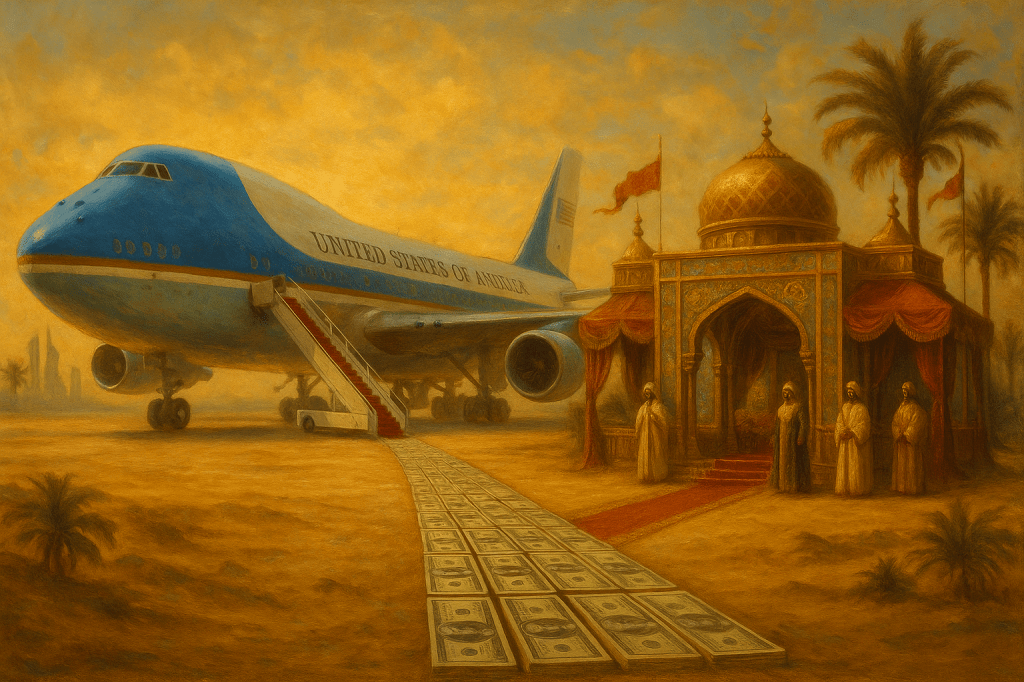
When President Donald Trump stepped off Air Force One in Riyadh this week, flanked by F-15 jets and greeted with lavender carpets and Arabian horse guards, he wasn’t just beginning a diplomatic tour. He was staging a pageant of personal alliances, transactional diplomacy, and rhetorical inversions of decades of U.S. foreign policy.
Over four days in Saudi Arabia, Qatar, and the United Arab Emirates, Trump announced major arms deals, investment pledges, and a sweeping rhetorical break from American interventionism. But behind the gilded rooms and opulent ceremonies, his visit reveals deeper shifts in U.S. priorities: away from democratic norms and toward a foreign policy of deals, gestures, and spectacle.
From Nation-Building to Non-Intervention?
In Riyadh, Trump declared the United States would no longer offer the Middle East “lectures on how to live,” denouncing what he called the arrogance of past nation-building efforts. Applauded by Gulf elites, his rhetoric echoed not Reaganite moral clarity nor liberal internationalism, but a kind of authoritarian libertarianism: you do you, as long as the checks clear.
The ironies abounded. His embrace of sovereignty resonated in a region exhausted by war, but also thrilled autocrats eager for fewer human rights constraints. Trump praised Crown Prince Mohammed bin Salman as an “incredible man,” ignoring the grisly murder of journalist Jamal Khashoggi and a broader record of internal repression. The message to strongmen was clear: governance style matters less than alignment with American business and strategic interests.
The Syria Pivot: Realpolitik in Real Time
Perhaps the most jarring moment of the trip was Trump’s meeting with Syria’s new president, Ahmed al-Shara—a former jihadist and one-time Al Qaeda affiliate. Posing with al-Shara and bin Salman, Trump declared his intent to lift decades-old U.S. sanctions, calling Syria’s new leader a “young, attractive guy” with a “strong past.”
This dramatic about-face—from designating al-Shara a terrorist to welcoming him as a statesman—underscores the fluidity of Trump-era diplomacy. Moral consistency gave way to strategic recalibration. Al-Shara may be problematic, but he is not Assad. And if detente with Syria helps stabilize oil markets, contain Iran, and pave the way for business ties? Then so be it.
Of course, many Syrians celebrated the prospect of sanctions relief. But others worried that a new phase of sectarian fragmentation may follow, now stripped of external accountability. For human rights advocates, the message was sobering: U.S. engagement is now transactional, not transformational.
The Qatar Contradiction
Trump’s next stop was Doha, where the emir of Qatar rolled out an extravagant welcome, including a red carpet, ceremonial camel escort, and the promise of $200 billion in aircraft deals. Trump returned the favor with lavish praise—a sharp turn from his 2017 accusation that Qatar funded terrorism.
The most controversial episode? The emirate’s offer of a luxury Boeing 747 to serve as Air Force One. Trump’s suggestion that he might accept the jet as a “gift to the country” sparked bipartisan outrage at home. Critics questioned the ethics and security risks. Even within MAGA circles, voices like Ben Shapiro asked how Qatar’s largesse squared with “America First.”
But for Trump, Qatar’s checkbook diplomacy was a vindication. It proved that his mix of swagger, loyalty rewards, and business-friendly politics could reshape global relationships—or at least the perception of them.
The Blurred Line Between Soft Power and Self-Promotion
Amid the pomp, one figure stood out: FIFA President Gianni Infantino, who joined Trump’s Gulf tour and presided over a handover ceremony for the 2026 World Cup. The event symbolized something larger. Trump was not just making policy; he was producing a global narrative of influence, legitimacy, and personal brand consolidation.
He was also closing the loop between politics and business. The Trump Organization, still controlled by his children, recently inked a development deal in Qatar. Trump himself sang along to “God Bless the U.S.A.” in a ballroom decorated with gold leaf while defense contractors and investors eyed megaprojects like “The Line” in Saudi Arabia.
To his critics, this wasn’t diplomacy. It was a personal infomercial, draped in the flags of allies and underwritten by sovereign wealth. To supporters, it was pragmatic leadership in a post-ideological world.
A Turning Point, but Toward What?
Trump’s Middle East visit may go down as a historic moment—but not for its policy achievements. Its true significance lies in what it reveals about the direction of U.S. global engagement. Not a withdrawal, but a redefinition. Not an abandonment of interests, but a reframing of values.
In a world increasingly shaped by strategic fluidity, where strongmen find common ground in mutual non-interference and wealth, Trump offered a vision devoid of moral pretense. It was blunt. It was effective. And it was dangerous.
Because American power has never rested on might alone. It has been persuasive because it was tied, however imperfectly, to ideals: the dignity of individuals, the rule of law, the belief that freedom is not just a privilege of the West but a right of all.
We must not lose sight of those principles in the glow of transactional success. Engagement matters. Prudence matters. But so do convictions.
The challenge ahead is not only to critique what this visit represents, but to chart a better path. One where American leadership inspires not because it flatters, but because it uplifts. Where sovereignty is respected, but so is courage in defense of human rights.
That path requires more than gold-plated ceremonies or billion-dollar deals. It requires a foreign policy rooted not in nostalgia or convenience, but in principle — one that recognizes human dignity as a strategic asset, not a liability. It means building partnerships that empower civil societies, not just ruling elites; defending sovereignty without sacrificing justice; and remembering that credibility is not bought with contracts, but earned through consistency.
The next chapter of American leadership in the world won’t be written in gold leaf or signed in backrooms. It will be forged wherever courage meets conscience — in classrooms, courts, and quiet acts of solidarity. Because history does not remember those who merely made deals. It remembers those who dared to stand for something greater.

 USPH
USPH 
Leave a comment