
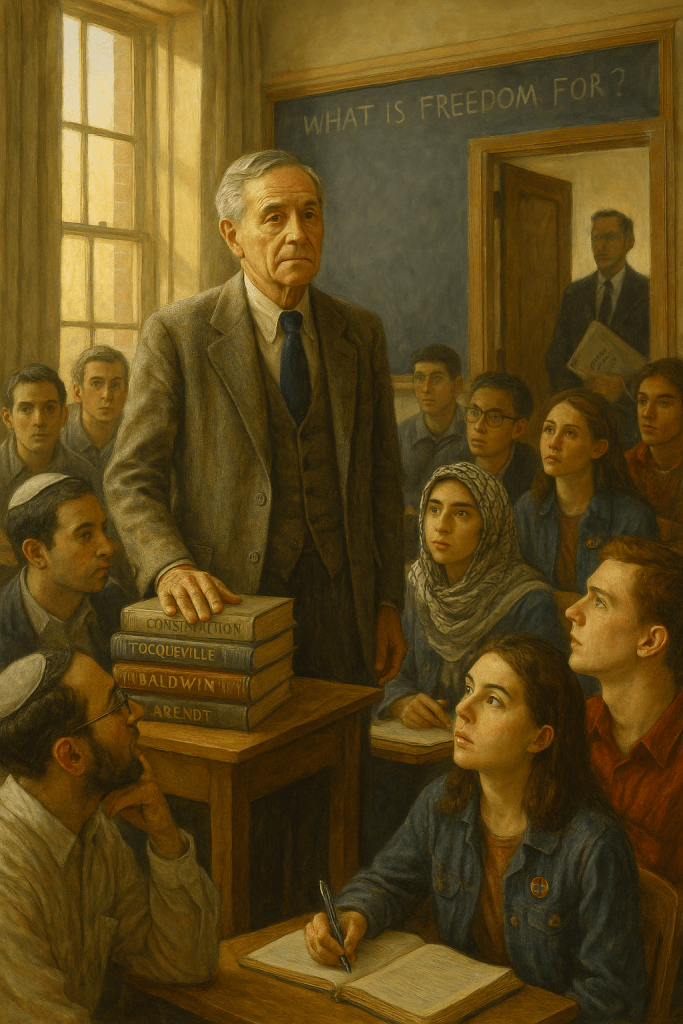
I. Introduction: When Education Becomes a Battleground
In the spring of 2025, American universities once again found themselves at the center of a national culture war. In early May, the Trump administration announced that several elite institutions — including Harvard and Columbia — would be subject to federal funding reviews, citing concerns about antisemitism, ideological imbalance, and a failure to “uphold American values.” These moves, framed by allies of the president as a defense of free speech and religious freedom, came after months of tensions surrounding pro-Palestinian protests on campuses, student encampments, and faculty statements critical of U.S. foreign policy. In a more assertive tone than ever before, the Department of Education hinted that the days of institutional independence were over: “Taxpayer money should not support hatred, extremism, or intellectual echo chambers.”
This moment is not without precedent. In fact, it echoes an enduring theme in American political life: the urge to bring universities — those bastions of critical thought and often inconvenient dissent — under ideological supervision. From the Red Scare of the 1950s to battles over ethnic studies in the 1990s, political pressure on higher education has never truly disappeared. What is striking today is the intensity, centralization, and presidential personalization of the attack. And behind it all lies a fundamental question about the relationship between knowledge, power, and democracy.
In this essay, I propose to revisit this question by placing the current campaign against universities in historical perspective. What can the history of McCarthyism and other waves of political interference teach us about the present moment? How have American institutions responded — or failed to respond — to such pressure in the past? And what does this tension reveal about the health of democratic culture in 2025?
II. Historical Parallels: The Long Shadow of McCarthyism
When Senator Joseph McCarthy rose to national prominence in the early 1950s, it was not only the federal government or Hollywood that became targets of his anti-communist crusade. Universities — long viewed by conservatives as hotbeds of leftist ideology and moral laxity — soon fell under scrutiny. Professors were called before congressional committees. Loyalty oaths were demanded by state legislatures. Tenure protections, academic freedom, and institutional autonomy were suddenly conditional on ideological compliance. By 1952, over 30 states had enacted laws requiring university employees to swear they had never been affiliated with the Communist Party. Several institutions — including the University of California — dismissed faculty who refused.
The fear was not just of espionage, but of ideas. Books were banned. Critical voices silenced. “Subversive” thinkers were driven out of classrooms and libraries. As historian Ellen Schrecker has noted, McCarthyism was not simply a political phenomenon — it was an intellectual purge. And the damage, though difficult to quantify, was profound: generations of scholars were intimidated into self-censorship, disciplines like sociology and history were politically constrained, and a precedent was set that the state could act as arbiter of acceptable thought.
Importantly, the Supreme Court did not always come to the defense of academic freedom. In Adler v. Board of Education (1952), the Court upheld New York State’s right to exclude teachers based on suspected political affiliations. It would take over a decade — and the cultural shift of the 1960s — for jurisprudence to more consistently protect the rights of educators and students to dissent. But by then, the damage was done. McCarthyism had established a lasting model: weaponize patriotic rhetoric, exploit public fear, and target the academy as the enemy within.
Today’s crackdown does not involve loyalty oaths or HUAC hearings. Yet the underlying logic feels eerily familiar. Once again, the specter of ideological contamination is invoked — this time not by Communists but by “wokeism,” “anti-Americanism,” or “radical Islam.” Once again, federal power is being deployed to discipline discourse, under the guise of moral clarity. And once again, universities are being asked to choose between funding and freedom.
What distinguishes 2025 from 1955, however, is not just the language of the attacks — it is their centralization. McCarthy, for all his theatrical power, was still a senator operating within a broader congressional machine. Today’s offensive is being orchestrated from the executive branch itself, through an emboldened Department of Education, reinforced by executive orders and the ideological framework of Project 2025 — a document drafted by conservative think tanks envisioning the total restructuring of federal authority, including its role in shaping education.
This brings us to the heart of the present crisis: not merely an echo of past interference, but an escalation. In 2025, political intervention in academia is not the symptom of a rogue legislator — it is fast becoming official doctrine.
III. Present Dynamics: The Logic of the Current Crackdown
The events of spring 2025 did not erupt in a vacuum. Since returning to power, President Trump has intensified efforts to remake key American institutions in his image — not only the Department of Justice and the intelligence community, but also the educational sphere. This campaign reflects both political opportunism and a deeper ideological conviction: that American universities are breeding grounds for dissent, decadence, and disloyalty.
At the center of this campaign lies a carefully orchestrated narrative. Conservative media outlets — from Fox News to smaller right-wing platforms — have spent months portraying elite universities as chaotic spaces overrun by “pro-terrorist” demonstrators, “Marxist” professors, and administrators “too cowardly” to uphold order. This portrayal reached a fever pitch in April 2025, when pro-Palestinian encampments at Columbia and UCLA made headlines worldwide. Though the protests were largely peaceful, isolated incidents of antisemitic rhetoric (condemned by the schools themselves) became the pretext for sweeping generalizations — and soon, sweeping federal actions.
The administration’s response has been twofold:
- Financial Leverage: The Department of Education announced it would review the Title VI funding of several universities, questioning whether they still comply with the Civil Rights Act’s anti-discrimination clauses. This move effectively links ideological conformity to civil rights enforcement — a dangerous precedent.
- Legislative Pressure: Congressional allies have introduced bills to cut federal grants to any institution found to “promote antisemitism, cultural Marxism, or anti-American values.” While such terms remain undefined, the ambiguity is precisely the point: it allows selective targeting of perceived enemies.
This crackdown is not limited to university administrations. Individual faculty members are under scrutiny. Professors who publicly criticize the Israeli government or U.S. foreign policy have been denounced by lawmakers. Some have received threats. Campus diversity programs — especially those focused on race or gender — are being recast as ideologically subversive, and flagged for defunding or elimination.
The stated rationale is to “restore balance.” But the underlying motive appears far more calculated: to reshape the intellectual landscape by silencing or marginalizing dissenting voices, and to recode loyalty to the state as a prerequisite for academic legitimacy.
What makes this moment distinct is the central role of executive power. Unlike previous conservative waves — which relied on think tanks, local legislatures, or grassroots pressure — the current campaign is being executed from the White House. The president’s public language leaves little doubt: “If these institutions want American money, they must uphold American values.” The implication is clear — and chilling. Education is no longer seen as a space for critical inquiry or civic formation. It is viewed as a strategic front, one to be conquered.
Yet history teaches us that when the state uses its full power to police thought, the consequences extend far beyond the campus gates. What is at stake is not merely academic freedom, but the democratic fabric itself.
IV. Implications for Democracy: When the University Is No Longer Sacred
Throughout American history, universities have served not only as centers of learning, but as laboratories of democratic life. They are where dissent is sharpened, where inconvenient questions are asked, and where tomorrow’s citizens are shaped. When power feels threatened by ideas, the university is often the first to be targeted — because it remains one of the few institutions built on the premise that truth-seeking matters more than allegiance.
The current assault on higher education is more than a policy dispute — it is a test of the democratic contract. At its core lies a fundamental contradiction: the government demands ideological conformity from the very institutions whose purpose is to foster free thought. This is not a tension to be “managed.” It is a red line.
What is at risk is twofold:
- The Autonomy of Knowledge: If universities are forced to align with the ideological preferences of whoever holds the presidency, the idea of independent scholarship collapses. Research becomes a tool of power, not a challenge to it. Dissent becomes disloyalty. The university becomes not a space for formation, but for indoctrination.
- The Habits of Citizenship: Democracies rely on citizens who can weigh competing arguments, tolerate difference, and change their minds. These are not instincts — they are cultivated, and often first encountered in educational settings. When the state undermines that cultivation, it hollows out the very soil in which democratic life grows.
The threat today is systemic because it is normalized. It comes not from firebrand senators or rogue administrators, but from executive memoranda and federal agencies — clothed in legal language, framed as “balance” or “anti-discrimination.” But the effect is the same as in McCarthy’s time: a chilling of speech, a narrowing of thought, and a warning to future students and scholars — there are boundaries you do not cross.
This campaign is also part of a broader pattern: the centralization of power around the presidency. Project 2025, the blueprint quietly guiding many of these initiatives, envisions a government where the executive not only directs policy, but polices culture — and education is among its chief targets. The very notion that ideas should exist beyond the reach of presidential authority is recast as subversive. And in this framework, the university — precisely because it defends complexity and pluralism — becomes a liability.
But if universities are to remain worthy of their democratic role, they must respond. Not with vague statements or procedural defenses, but with clarity. They must defend the principle of autonomy — not as a privilege, but as a duty. They must be willing to confront the state when it oversteps, and to remind the public that the health of a democracy can be measured by how well it tolerates dissent — especially from its youth.
V. Conclusion: Defending the University, Defending Democracy
If there is one lesson to be drawn from this historical arc — from the loyalty oaths of the 1950s to the executive decrees of 2025 — it is that the battle for democracy does not always begin at the ballot box. Sometimes it begins in a classroom. Sometimes it begins with an idea that refuses to flatter power. And sometimes, it begins with the quiet erosion of spaces meant to be free.
Today’s campaign against higher education is not an isolated policy shift. It is part of a broader effort to recode loyalty as obedience, to reduce civic life to partisanship, and to teach future generations that critical inquiry is a threat, not a virtue. It must be resisted — not because universities are perfect, but because without imperfect spaces for dissent, no democracy survives long.
But resistance must be more than symbolic. It must be strategic, credible, and courageous. That means:
- Universities must stop hiding behind procedural neutrality. They must make the case — publicly, repeatedly — that their autonomy is not a corporatist privilege but a public good. They must defend the right to be wrong, to disagree, to challenge. And they must do so in language that speaks not just to donors and lawyers, but to the people whose trust they must regain.
- Faculty must reclaim their voice as civic actors. Not with dogmatism, but with clarity. The goal is not to preach from the lectern, but to model what it means to think freely and responsibly. This is not a time for retreating into research or silence. It is a time to stand, collectively, for the values that make scholarship worth pursuing.
- Students must not be left alone on the front lines. The youth of today are not radicals — they are heirs to a civic tradition older than any executive order. When they protest, they often do so imperfectly — but to silence them is to declare that future citizens have no role in shaping the present. Instead, institutions must educate, engage, and sometimes even protect them — not as mascots, but as participants in democracy.
- The public must be invited back into the university. One reason these attacks resonate is that many Americans feel alienated from academia — perceiving it as elitist, insulated, or indifferent to real-world concerns. Universities must show, not just say, that they serve the common good: through open lectures, community partnerships, adult education, and plainspoken civic engagement. The university must stop defending its walls, and start opening its doors.
At the same time, defending academic freedom does not mean denying the real challenges that exist on campus. Acts of antisemitism — whether overt or coded — have occurred and must be addressed with seriousness and resolve. Universities have a duty not only to protect intellectual dissent, but also to ensure that all students — including Jewish students and other historically marginalized groups — feel safe, respected, and heard. The challenge is to do both: to uphold free inquiry without tolerating hatred, and to protect pluralism without yielding to political blackmail.
And finally, there must be a broader cultural recognition that academic freedom is not a luxury — it is a foundation. No nation that aspires to liberty can afford to train its future citizens in fear. No democracy that forgets how to think will long remember how to choose.
The task ahead is not easy. The forces that seek to dominate the intellectual landscape are organized, well-funded, and relentless. But they can be confronted — not with slogans, but with substance. Not with purity, but with courage. And not alone, but together.
The university is not a threat to the republic — it is where the republic is tested.
When power demands silence, they must remain places where freedom learns to speak.
In defending them, we are not protecting an institution — we are preserving the future of democratic life itself.
Welcome to the conversation.

 USPH
USPH 
Leave a comment