
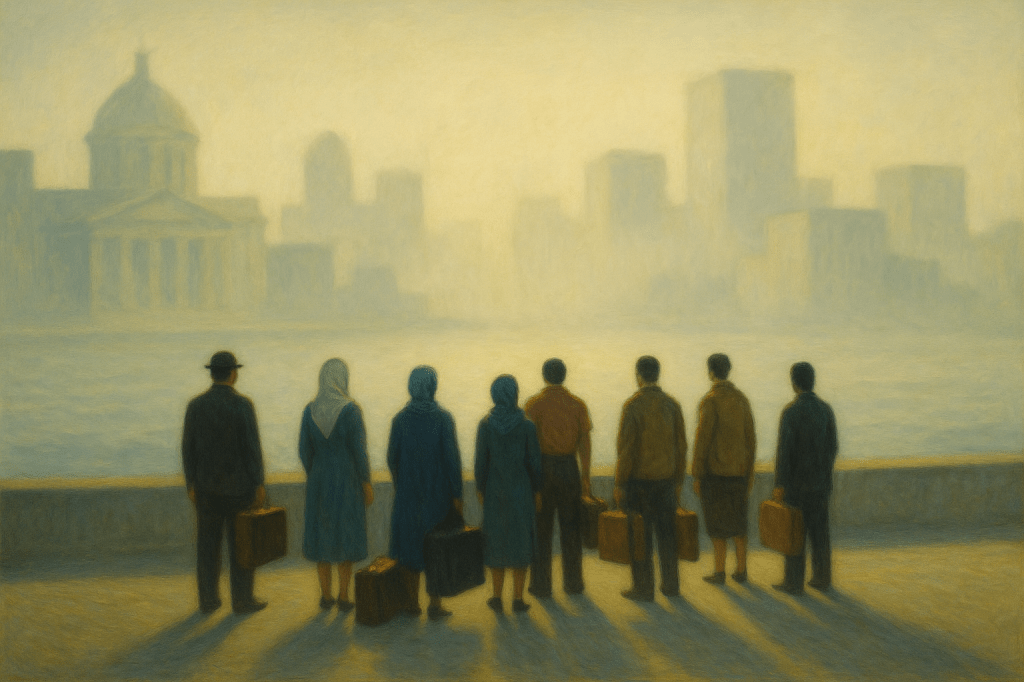
In recent years, the idea of a “Great Replacement” has gained traction in political rhetoric across the West. From Europe to the United States, this notion suggests that demographic change driven by immigration is eroding the cultural fabric of Western societies. But while some voices denounce the growing presence of immigrants as an existential threat, they often miss a more uncomfortable truth: the real crisis is not the arrival of the Other, but the abandonment of ourselves.
The Western world is not being replaced by force. It is quietly dissolving from within.
I. When the Center No Longer Holds
Western societies today suffer not from external invasion but from internal erosion. Over the past half-century, the West has undergone rapid transformations: secularization, technological acceleration, hyper-individualism, economic dislocation, and institutional distrust. The net result is a weakening of the cultural glue that once held diverse populations together.
In the United States, this has taken the form of a declining sense of civic belonging. The shared narratives that once sustained American pluralism—the Constitution, the civil rights movement, even the frontier mythos—have fractured. Education no longer transmits a coherent civic story. Religious affiliation has dropped precipitously. Loneliness, tribalism, and resentment have filled the void.
In Europe, the collapse of grand ideological projects—Christianity, socialism, even European integration—has left a vacuum. And when a civilization no longer produces meaning, identity, or hope, it cannot expect newcomers to “integrate” into anything solid.
II. Culture as Production, Not Heritage
Culture is not a museum piece. It is not something to be guarded like an antique. It is something to be produced, enacted, and reinterpreted across generations. When we speak of a “Western” or “American” identity, we refer not to bloodlines or borders, but to a living inheritance of ideas: the dignity of the individual, the rule of law, the search for truth, the tension between liberty and responsibility.
But these principles must be taught, debated, celebrated, challenged. They must live in schools, in arts, in rituals, in public spaces. When we cease to do this—when culture becomes merely entertainment, or worse, a matter of consumption—we abandon the very stage upon which democratic life depends.
It is not immigration that erodes culture—it is our failure to sustain it
III. The Immigrant as Mirror
Ironically, many immigrants are still drawn to the West, but not necessarily because they believe in its values. They come for more tangible reasons: economic opportunity, physical safety, political stability, education for their children. These are powerful motivations, rooted in need rather than in ideological alignment. And that is neither surprising nor blameworthy. One does not need to be a philosopher of liberal democracy to seek a better life.
But this also means that immigrants do not arrive pre-integrated, ready to embrace the customs, narratives, or institutions of their host societies. Nor should they be expected to. It is not the migrant’s duty to reanimate the civic spirit of the West. That burden lies squarely with the societies that claim to embody it.
When those societies are no longer able—or willing—to clearly express what they stand for, they offer little to integrate into. The question is not why immigrants cluster in enclaves or retain strong ties to their native cultures. The question is why the host society no longer radiates enough cultural coherence to draw people in. A strong culture does not require forceful assimilation. It attracts. It inspires. It compels by example.
In the absence of such gravitational pull, people turn inward. Community becomes private, identity becomes defensive, and difference hardens into division. Integration fails not because immigrants reject it, but because the invitation was unclear—or never made. And when the dominant culture ceases to believe in itself, it can no longer ask others to believe in it either.
The immigrant, then, becomes a mirror—not of foreign threat, but of domestic loss. Their presence reveals not the weakness of the newcomer, but the fragility of the cultural house into which they have stepped. A house that does not speak, does not welcome, and does not know quite what it is anymore.
IV. The Hard Work of Cultural Regeneration
The answer to the West’s cultural erosion is not a wall or a ban. It is not a return to some mythical golden age. It is the difficult, creative, and necessary work of civic regeneration. If the West is to endure, it must not merely remember who it was—it must become someone worth becoming again.
This begins with education—not just technical training or test preparation, but the formation of citizens. Civic education must be reimagined as a national priority, not as an afterthought. Students should leave school not only equipped for the job market, but grounded in the philosophical, historical, and ethical frameworks that sustain democracy. This means reinvesting in the humanities, yes—but also in pedagogy that cultivates critical thinking, pluralist dialogue, and civic imagination.
Such reform does not require utopian resources. Redirecting a small percentage of existing education budgets—comparable to what is already allocated for digitalization or STEM initiatives—can support curriculum development, teacher training, and partnerships with civil society. The point is not to spend more, but to spend more meaningfully.
Next, civic regeneration requires spaces of belonging. Public libraries, local unions, community centers, sports clubs, places of worship—these are not nostalgic relics of a bygone era. They are the invisible infrastructure of democratic life. They foster encounters, trust, memory, and initiative. When they disappear, people do not stop needing community—they look for it in tribalized, often more toxic, alternatives.
Governments can support this fabric through modest but strategic funding, favoring projects that promote intergenerational exchange, cross-cultural collaboration, or public deliberation. Revitalizing civic life does not mean inventing new bureaucracies. It means strengthening what already exists, often at the municipal level, with targeted grants and light-touch coordination.
Third, this cultural work demands a new ethic of citizenship. For decades, Western democracies have reduced citizenship to a transactional status: vote every few years, pay taxes, enjoy rights. But citizenship is not a product—it is a practice. It calls for participation, responsibility, and shared meaning.
Some countries already experiment with this idea. Service programs like AmeriCorps in the U.S., Service Civique in France, or national volunteer initiatives across Europe show what is possible. These programs are relatively inexpensive, and they generate strong returns in civic engagement, social cohesion, and upward mobility. Scaling such efforts—and linking them to cultural and democratic goals—would be a powerful investment in the long-term resilience of liberal societies.
Finally, civic regeneration calls on cultural producers—artists, writers, educators, journalists, local leaders—to stop merely critiquing decline and start imagining repair. Public storytelling, shared rituals, creative forums, and national commemorations all have a role to play. Even modest public arts funding, if well targeted, can help reinvigorate a shared sense of belonging and possibility.
In all these domains, the challenge is not budgetary excess. It is moral clarity and political will. Civic regeneration does not demand mass surveillance, mass incarceration, or massive spending. It requires trust in the democratic process and in the people themselves. And yes, it means asking something of immigrants—but only after asking far more of ourselves.
Integration cannot be a one-way demand. It must be a two-way invitation. Immigrants cannot be expected to embrace values that are no longer visible in public life. If we want them to feel part of the story, we must have a story to tell—and a place to live it out together.
Reclaiming the civic soul is not nostalgia. It is renewal. It is not about retreating from the world, but about facing it with enough confidence to offer meaning again. The real replacement is not demographic. It is civilizational. And the answer is not exclusion—it is creation.
V. Conclusion: An Empty House Cannot Welcome
What many fear as “replacement” is, at its core, a misdiagnosed crisis of meaning. The West is not collapsing because others are arriving. It is faltering because it has forgotten how to generate purpose from within. What looks like external threat is often a mirror reflecting internal fatigue.
A culture that no longer believes in itself cannot be defended with borders or slogans. It must be reborn through action, through imagination, through responsibility. We do not suffer from too much difference—but from too little conviction. We have let the great experiment of democracy drift, mistaking comfort for strength and consumption for citizenship.
If we want to avoid replacement, we must stop abdicating. Abdicating the work of culture. Abdicating the education of future generations. Abdicating the practice of democracy. The great danger is not that we will be overrun—but that we will leave the field empty.
This is not a call to restore the West of the past. That world is gone—and with good reason in many cases. It is a call to rediscover the creative responsibility that made liberal societies resilient in the first place. The responsibility to teach what matters. To build what endures. To invite others into a common life that is demanding, but meaningful.
To resist replacement, we must not cling to identity as a relic, but embrace it as a responsibility. We must become authors of a living, evolving tradition—one that speaks to the future, not just the past. One that people from many backgrounds can choose to join, not out of fear, but because it offers something worth believing in.
In the end, the West will not be saved by defense. It will be saved by definition. Not of who we exclude, but of what we are building together.
Welcome to the conversation.

 USPH
USPH 
Leave a comment