
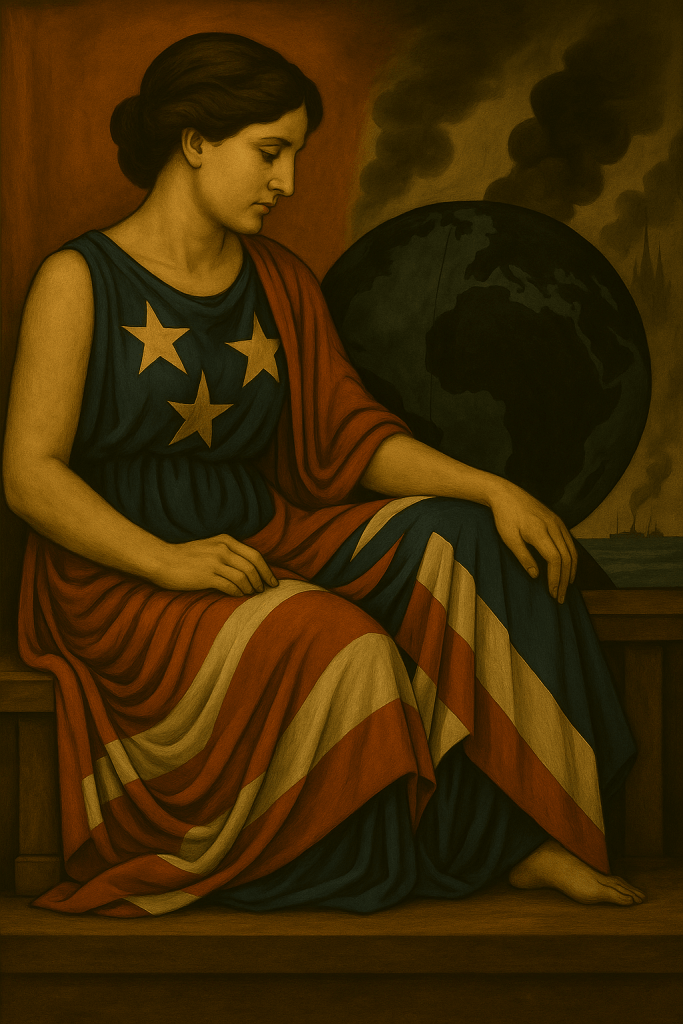
There was a time when American leadership was a given in world affairs—not only because of its military might or economic scale, but because of its reliability. Allies did not always agree with the United States, but they knew what it stood for. That clarity has faded.
The U.S. withdrawal or downgrading of its commitment to agencies like USAID—once a soft power tool with unmatched reach—sends ripples far beyond the bureaucratic beltway. It is not just a matter of cutting funds; it is a signal, received in dozens of languages across continents: the United States is no longer certain it wants to lead.
The reverberations are especially loud in Ukraine, where the Trump administration, having returned to power, now sends increasingly mixed signals about the durability of U.S. support. What was once cast as a transatlantic consensus is visibly fraying under the weight of American ambivalence, and Kyiv knows it.
The world has seen this film before.
I. Iraq and the Beginning of Doubt
The invasion of Iraq in 2003, launched under the pretense of weapons of mass destruction that never materialized, was not merely a strategic error—it was a moral rupture. The loss of life, the destabilization of a region, and the manipulation of intelligence corroded the image of the United States as a principled actor.
Alliances bent under the strain. Trust took a hit that no speech or summit could fully repair. Even traditional allies like France and Germany distanced themselves. It was in that moment that many began to question not only America’s decisions, but its sincerity.
This moment marks the beginning of what might be called the long erosion—the slow, compounding accumulation of disillusionment. What made the Iraq episode particularly damaging was not only the policy failure, but the dogged insistence on its righteousness. For much of the world, it was proof that American power could be reckless and unaccountable.
II. 2014: A Deafening Silence
When Russia annexed Crimea in 2014, the international response was swift in words but hesitant in action. Sanctions were applied. Statements were issued. But the Kremlin’s wager—that the West would not muster the will to confront a nuclear power—proved correct.
To many in Eastern Europe, it felt like confirmation: the age of automatic American engagement was over. While NATO maintained its integrity on paper, and the Obama administration upheld diplomatic pressure, the absence of a tangible deterrent sent a different message. Power, it seemed, no longer carried promise. It merely cast a shadow.
The annexation of Crimea should have been a turning point. Instead, it became a precedent.
III. The Hypothetical of 1776
To grasp what is truly at stake in Ukraine today, it helps to look backward—not to compare, but to reflect. What would have become of the American Revolution if France had watched from the sidelines?
It’s a question that feels almost absurd, yet illuminating. France, motivated by its own geopolitical interests as much as Enlightenment ideals, took a bold and risky gamble by supporting the American colonies against Britain. Without French naval power, arms, and finance, it is difficult to imagine the ragtag revolutionaries winning at Yorktown.
We should be cautious here. Comparisons are not equations. Ukraine is not Virginia. Russia is not 18th-century Britain. And France’s motivations in 1778 were not purely altruistic. But the point is not historical symmetry—it is moral reciprocity. Would-be democracies do not survive on slogans. They survive on solidarity.
In that light, today’s ambiguity in Washington is not just a policy dilemma. It’s a signal to those who fight for democratic survival that the world’s most powerful democracy might hesitate when it matters most. The credibility of a republic is measured in what it does when the world is watching, and when the cost of action is high.
IV. The Crisis of Confidence: Aid and Ambiguity
Today, the signs are multiplying. The drawdown of U.S. development assistance, whether symbolic or structural, undermines decades of effort in places where American engagement has brought not only economic results but democratic norms. A nation’s influence is not only a function of its army—it is the sum of its presence.
In countries where authoritarian models are gaining ground, American absence is interpreted as indifference. When USAID funding is reduced or redirected according to short-term political logic, the result is not neutrality. It is retreat. And into that vacuum flows a very different kind of influence—from Moscow, from Beijing, from regimes that make no pretense of values.
If American leadership is to mean anything, it must rest not only on interests but on constancy.
V. The Temptation of Isolationism
In times of domestic upheaval, isolationism can feel like prudence. Why spend blood and treasure abroad when there are crises at home? Why bear the burden of others’ battles? These are not unserious questions.
But the idea that the United States can remain prosperous and secure while disengaging from the world is not only naive—it is dangerous. Power abhors a vacuum. When America retreats, others do not wait politely.
China expands its influence in Africa and the Pacific. Russia exploits confusion in Europe and the Caucasus. Autocracies test the limits of Western resolve. And nations once aligned with Washington begin to hedge their bets.
The illusion that America can disentangle itself from the world while preserving its influence is not only self-defeating—it is historically blind. The post-1945 world, with all its flaws, was shaped in large part by American engagement. Pulling back from that world is not a return to order. It is a descent into entropy.
V. The Price of Retreat: What Credibility Really Means
America’s credibility is not an abstract virtue. It is a currency, earned slowly and spent quickly. To preserve it, presence matters. So does consistency. Allies need not always be reassured, but they must never be surprised. This means committing to predictable diplomacy, maintaining open lines of engagement even during partisan transitions, and aligning rhetoric with action in both peace and conflict.
What is at stake is more than image. It is the very fabric of the liberal order the United States helped build. And if that fabric unravels, history will not care that we were tired, or divided, or distracted. It will not judge intentions—only outcomes.
So what might renewal look like? It begins with restoring strategic coherence across administrations. It means rebuilding international development institutions, supporting independent media abroad, and investing in long-term partnerships rather than short-term optics. It requires reinvesting in our diplomatic corps, and recognizing that soft power is not charity—it is leverage.
For readers who want to understand the deeper mechanics of America’s international standing, I recommend Anne-Marie Slaughter’s “The Chessboard and the Web,” which explores networked power in the 21st century, and Robert Kagan’s “The Jungle Grows Back,” a sobering reminder of what’s at stake when liberal order retreats. For a more critical lens, Stephen Wertheim’s “Tomorrow, the World” traces the historical roots and debates around U.S. interventionism.
Ultimately, the question we must ask is not whether America can afford to lead, but whether the world can afford an America that refuses to. If we abandon the architecture we helped build, we do not leave it intact—we leave it vulnerable to forces that do not share our ideals.
History will not care about our fatigue. It will simply record that the republic looked inward when the world needed it most.
Welcome to the conversation.

 USPH
USPH 
Leave a comment