
I. The Politics of Diagnosis Without Cure
Donald Trump is often dismissed by his opponents as a charlatan or clown, but this is a mistake — not because he is not performative, but because performance has always been a part of politics. What makes Trump singular is his gift for diagnosing the pain points of American society in language that many feel but few politicians dare use.
He talks about the southern border in apocalyptic terms. He calls out the offshoring of American jobs. He decries the “forever wars” and promises he could end the war in Ukraine in 24 hours. He says what many believe: that the system is broken, that America is being taken advantage of, and that the elites do not care.
And to be fair — some of these concerns are valid.
Illegal immigration has placed genuine pressure on local services in certain states. Trade deals have, in some cases, disproportionately benefited multinational corporations while hollowing out the American industrial base. The war in Ukraine is a geopolitical powder keg. Trump is not wrong to bring these issues to the fore. Where he falls short — profoundly and dangerously short — is in his inability or unwillingness to offer coherent, feasible solutions.
II. Tariff Nationalism and the Japan Negotiations
One recent example illustrates this vividly. In April 2025, Japan’s chief trade negotiator, Ryosei Akazawa, came to Washington following Trump’s announcement of new tariffs on imported steel and automobiles. Japan, a long-standing ally of the U.S., sought dialogue and clarity. But as Reuters reported, the American delegation — despite having initiated the confrontation — had no specific counter-demands. Japanese officials asked what the U.S. wanted; the Americans had no answer.
This is not negotiation. It’s not even brinkmanship. It’s theater.
Trade policy is not a tweet. It requires strategic planning, cross-sector consultation, and multilateral understanding. What we saw in the U.S.-Japan exchange was not a show of strength, but a revelation of vacuity. It’s a recurring theme. In Trump’s first term, tariff policies on China were announced and celebrated without a coordinated plan for mitigation or enforcement. American farmers were left exposed to retaliatory tariffs. Manufacturers faced increased costs. In the end, the trade deficit remained largely unchanged — but the political optics were intact.
This is populism without substance: the identification of real pain with no viable path to relief.
III. The Populist Mirror
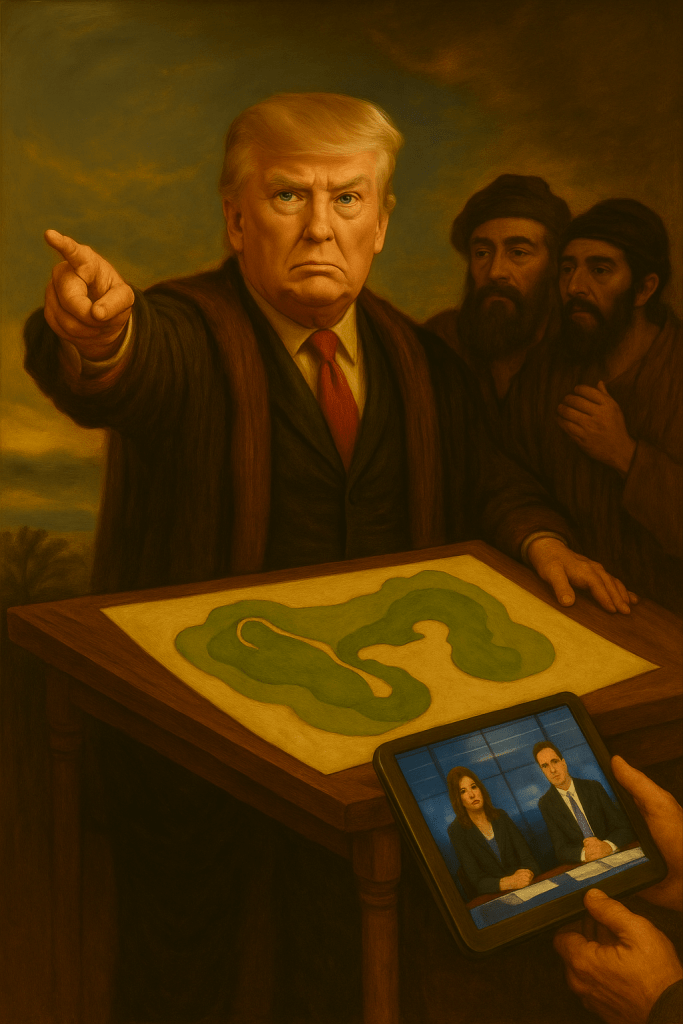
Trump holds up a mirror to America’s dysfunctions, and many Americans see their own disillusionment reflected back. But he doesn’t hold out a map. Instead, he invites voters into a continuous state of grievance, a loop of outrage that confirms their fears but never resolves them. In this way, Trumpism is not a political movement so much as a mood — a form of ambient discontent that thrives on spectacle, not strategy.
On immigration, Trump’s “build the wall” mantra remains emblematic. Even when he held the White House and both chambers of Congress, the wall was never completed, never fully funded, never defined in terms of actual border management outcomes. The spectacle was the policy.
On foreign policy, his claim that he could end the war in Ukraine in 24 hours is compelling to those exhausted by endless wars. But how? By cutting aid? By abandoning Ukraine to Russian demands? By making a deal with Putin that Congress and NATO would reject? There is no answer — because the statement is not meant to be a policy. It is a provocation, a posture.
IV. The Historical Echo: When the Empty Threat is the Message
There is an anecdote that comes to mind. During past trade frictions with Japan in the 1980s — a time when the U.S. faced rising anxiety over Japanese exports — American negotiators would sometimes call for action but fail to articulate what, exactly, they wanted in return. This pattern is repeating.
In 2025, Japan again tried to play the adult in the room, seeking a way to preserve cooperation and stability. The Trump team responded with ambiguity, bluster, and a refusal to define terms. The irony is that this is not strength; it’s impotence disguised as defiance.
V. Why It Matters
This matters because real problems demand real answers. Immigration reform is needed. Trade relations do need to be rebalanced in the context of global labor inequality and environmental standards. The war in Ukraine does require strategic thinking and serious diplomacy. These are not populist slogans — they are complex, often painful realities.
When a politician raises the right questions but refuses to engage with the complexity of answers, what we are left with is political nihilism. Governance becomes theater. Policy becomes emotion. The electorate becomes locked in a cycle of anger and disappointment — which, perversely, only feeds the same populism that failed them in the first place.
We need something more. We need leaders who are not just mirrors of our pain, but architects of possible futures.
Welcome to the conversation.

 USPH
USPH 
Leave a comment