
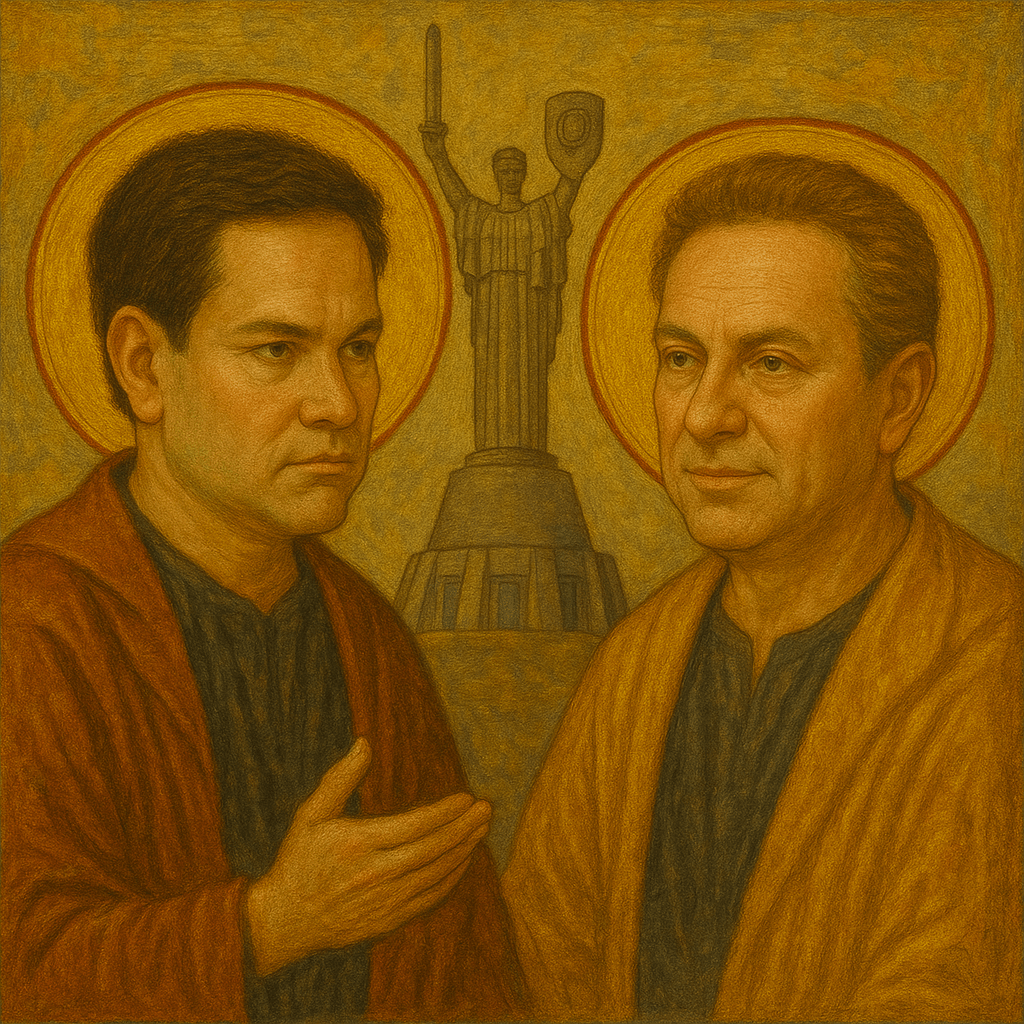
When we speak of oligarchies, we tend to picture distant regimes — shadowy cliques of billionaires steering post-Soviet republics or Middle Eastern petro-states. But what if the slow drift toward oligarchic governance was happening not in the shadows of Moscow, but in the fluorescent-lit offices of Washington, D.C.? What if the engine of American foreign policy was being rewired — not through democratic deliberation, but through a tug-of-war between elected officials and unelected billionaires?
This is not speculation. It is unfolding before our eyes.
The recent struggle between Senator Marco Rubio and real estate mogul Steve Witkoff over the direction of U.S. foreign aid and influence, particularly in Ukraine, provides a stark window into the forces reshaping the American state. It’s a story of ambition, ideology, institutional erosion — and of how a democracy can lose its foreign policy compass when power is up for private bidding.
I. USAID: From Soft Power to Soft Target
In the annals of post-Cold War diplomacy, few institutions have done more to expand American influence than USAID. More than just a development agency, it has long been a pillar of America’s soft power — a signal to the world that U.S. leadership was not merely a matter of arms and trade, but of values and partnership.
The quiet dismantling of this legacy has accelerated under the guise of fiscal discipline and administrative “streamlining.” But make no mistake: the decision to severely curtail USAID’s authority and funding is political. And for Rubio — a long-time hawk on China, Venezuela, and Russia — it represents a strategic blow. Foreign aid, in his view, is a lever of containment. Without it, the ideological competition of the 21st century risks becoming purely militarized — a scenario Rubio knows the U.S. is ill-equipped to manage without friends and influence on the ground.
Yet, that very lever has now shifted into new hands — hands not held to account by any electorate.
II. The Rise of Witkoffism
Steve Witkoff is not a diplomat, a general, or a policy scholar. He is a billionaire real estate developer — and increasingly, a key player in shaping American foreign engagement. Through strategic proximity to Trump-aligned figures and his growing role in Republican funding networks, Witkoff has emerged as a power broker not only in real estate but in geopolitics.
The latest flashpoint? Ukraine. While Rubio has long framed the defense of Ukraine as a bulwark against autocracy, Witkoff’s circles see in the conflict both a business opportunity and a geopolitical nuisance. The shift of Ukrainian reconstruction policy — and more broadly of U.S. posture in Eastern Europe — into hands closer to Witkoff’s worldview marks a deeper transformation: from strategy to speculation, from diplomacy to deals.
In this framework, America’s response to war and instability is no longer driven by strategic consensus but by boardroom logic.
III. Oligarchy Is a Process, Not a Coup
The American public still imagines its government as led by elections, checks, and balances. But the real shift happens elsewhere — through appointments, contracts, budget lines, and informal influence. What we are witnessing is not the sudden rise of a junta, but the gradual replacement of institutional logic with personal access.
Rubio, for all his ideological rigidity, is at least an elected official operating within a system of accountability. Witkoff is not. And while their rivalry may look like a policy disagreement, it reveals something more profound: the hollowing-out of democratic oversight in favor of transactional politics. In such a system, foreign policy becomes an extension of domestic donor politics — a prize for the loyal, a tool for the few.
Ukraine is merely the first chapter. Taiwan, Latin America, the Sahel — these too may become arenas where American policy is not decided in the Situation Room, but in private meetings far from the public eye.
IV. Can the Republic Withstand This?
This is not about left or right. It is about whether foreign policy — the face a nation shows to the world — should be the domain of accountable institutions or private fortunes. The shift underway is not simply a Trumpian quirk. It is the symptom of decades of erosion: of expertise, of funding, of faith in the public sphere.
It is tempting to see in Rubio’s protest a rearguard action — the fading voice of a conservative establishment that once believed in global engagement. But even those who disagree with Rubio’s hawkish worldview should be concerned. For if his influence can be undone not through elections but by the whims of a financier, then who really governs?
Oligarchy doesn’t need a throne. It only needs an empty seat where the public should be.
Welcome to the conversation.

 USPH
USPH 
Leave a comment