
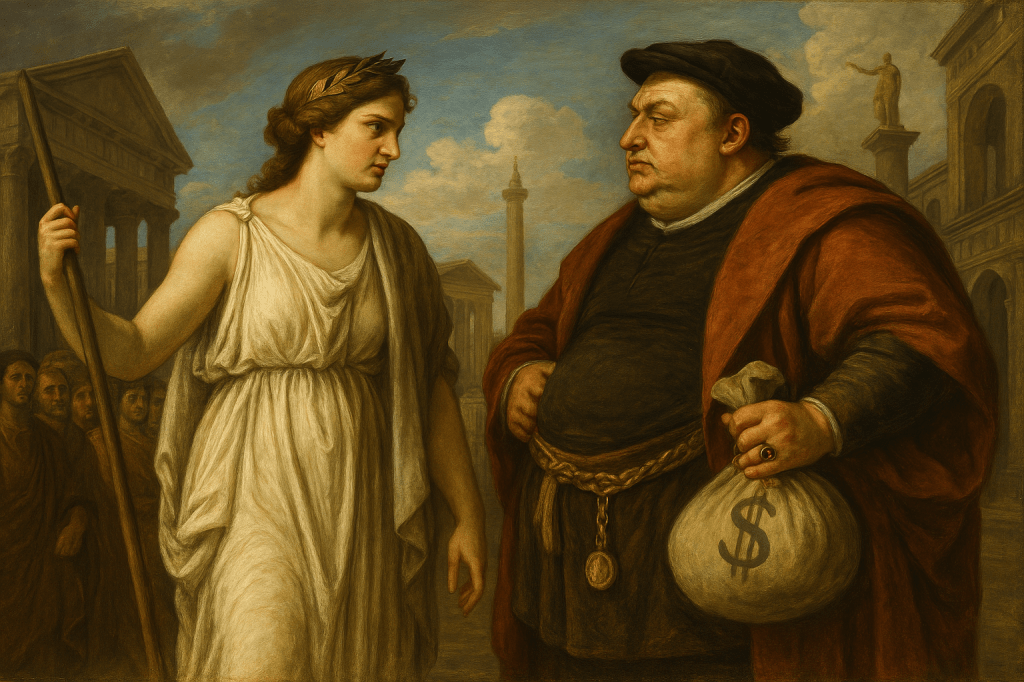
In the long arc of history, republics do not fall in a day. Their unraveling is often quiet, incremental—not through coups or collapses, but through corrosion. Power concentrates. Institutions bend. The public, weary or distracted, loses its grip on the levers of democracy. And slowly, the promise of self-government gives way to something far more fragile: oligarchy.
Today, the United States finds itself on such a precipice.
The signs are not subtle. An ever-smaller group of ultra-wealthy individuals and corporations now exerts outsized influence over American politics, media, and markets. Campaigns are shaped by billion-dollar donors. Legislation is written with lobbyists at the table. Economic policy often prioritizes asset holders over wage earners. And access to education, healthcare, and opportunity is increasingly filtered through the prism of wealth.
This is not the democratic ideal envisioned by the Founders—nor is it a new phenomenon in the annals of history.
I. Power Without Accountability: A Familiar Pattern
The rise of oligarchic structures in formally democratic systems has precedent. Perhaps the most instructive case in modern memory is post-Soviet Russia. After the collapse of communism, Russia experienced a brief democratic thaw. But amid chaos and rapid privatization, a small group of insiders—often former apparatchiks turned businessmen—amassed vast fortunes by acquiring undervalued state assets. These oligarchs quickly became the real power brokers, using wealth to control media outlets, manipulate elections, and shape policy.
Institutions were weak. Civil society was fractured. And the line between public office and private interest blurred to the point of invisibility.
By the early 2000s, this convergence of wealth and power had laid the groundwork for Vladimir Putin’s consolidation of authoritarian control—justified, paradoxically, as a way to tame the oligarchs and restore order. The result was a centralized system in which loyalty to the executive replaced rule of law, and where dissent came at increasing personal cost.
The United States is not Russia. Its institutions are stronger. Its civil society more resilient. But it would be a mistake to assume immunity from the same structural temptations.
II. A Democratic Façade, an Unequal Reality
The American experiment was born out of a rejection of aristocracy—a belief in the dignity of the common citizen and the imperative of accountable government. But that ideal is being undermined.
Today, nearly every major sector—from tech to pharmaceuticals to defense—is dominated by a handful of conglomerates. The wealth gap has reached levels not seen since the Gilded Age. Corporate PACs and dark money now shape elections with breathtaking opacity. Supreme Court decisions like Citizens United have further unleashed private capital into public life, transforming democratic participation into a bidding war.
Meanwhile, economic insecurity breeds cultural fragmentation. In place of shared facts and civic trust, polarization and disinformation flourish. And as institutional confidence erodes, strongman rhetoric becomes more appealing to voters who feel abandoned by an unresponsive system.
This is how democracies falter—not through a single event, but through a slow shift in the balance between public interest and private power.
III. A Crisis of Representation
In a healthy democracy, policy flows from public deliberation. But in an oligarchic drift, decisions are increasingly made in the shadows. Consider the revolving door between government agencies and the industries they regulate. Or the rise of executive orders and regulatory rollback as tools of governance, circumventing the messy process of legislative debate. Or the increasing reliance on billionaires not just to fund campaigns, but to “rescue” public institutions—from schools to space exploration.
This is not a left-vs-right issue. It is a question of legitimacy. Who governs? For whom?
When ordinary Americans feel that their vote matters less than a lobbyist’s check, when their voices are drowned out by think tanks financed by oil magnates or hedge funds, the very foundation of consent begins to crack.
IV. The Fork in the Road
America still has choices. The path is not predetermined. But reversing the oligarchic drift requires more than rhetorical concern—it demands structural reform:
- Campaign finance laws that restore transparency and limit the influence of money in politics.
- Stronger antitrust enforcement to prevent the monopolization of industry and innovation.
- Investment in public goods—education, infrastructure, healthcare—to reduce dependence on corporate charity and private monopolies.
- A renewed emphasis on civic education, so that citizens understand not only their rights, but their responsibilities.
It also requires cultural courage—a willingness to look past partisanship and ask harder questions about who benefits from the status quo and who is left behind.
V. A Republic, If We Can Keep It
When Benjamin Franklin was asked what kind of government the Constitutional Convention had created, his answer was terse but prophetic: “A republic, if you can keep it.”
Keeping the republic means defending not just the mechanics of elections, but the integrity of the public sphere. It means recognizing that economic power, left unchecked, can be as corrosive as political tyranny. And it means remembering that democracy is not just a system—it is a culture, a commitment, and a daily practice.
The Founders were not naïve idealists. They understood human nature—its ambitions, its fears, and its fragility. But they also believed that a people, bound by common purpose and guided by conscience, could govern themselves.
That belief is still worth fighting for.
And as long as we remember that the measure of a republic is not in the wealth of its elites, but in the empowerment of its citizens, the story of American democracy—strained though it may be—remains unwritten.

 USPH
USPH 
Leave a comment